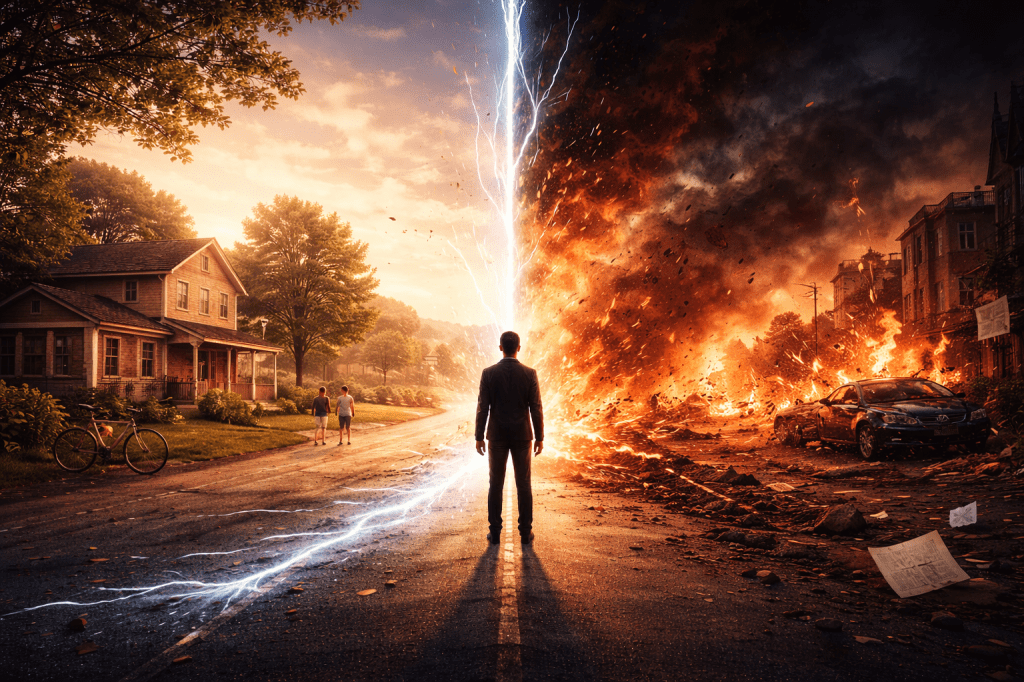
Suppose you are in your happy life. You have everything: a happy family, a successful career and trustworthy friends. Everything to you is beautiful and blissful. You are very thankful for this life, but suddenly an incident happens that completely turns your blissful life upside down.
Now, you have no family, no career, no one to share anything with. Tell me, how will you deal with that situation? Hard to imagine? This is the exact inciting incident every story demands.
In every powerful story, there is one defining moment that changes everything. That moment is called the inciting incident. This inciting incident is directly connected to the protagonist. Don’t compare it with other scenes. It is the most dramatic and sparkling event of the entire narrative.
If you are a writer struggling with a weaker inciting incident. If you are eager to learn about how to create a strong one, read this blog.
In this blog, I’ll discuss about what an inciting incident is. Why it matters. Where does it happen in a script with examples? And how to make a strong inciting incident?
Let’s dive into it.
What Is an Inciting Incident?
An inciting incident is the event that disrupts the protagonist’s normal world and forces them to choose a path they never desired. It is one of the most pivotal scenes in the story, setting the main narrative into motion.
Before the inciting incident, the protagonist follows their daily routine. Simply, the story setup is integrated before this event. The protagonist is busy with family, career, and ethics, but after that, everything changes. After that, new possibilities, conflicts, and transformations will be visible in the story.
The inciting incident challenges the main character. It impacts their beliefs, morals, relations, and decisions, and forces them to work on their strengths and weaknesses. You can say that it is the beginning of the central conflict.
For example, the inciting incident of Drishyam occurs when Vijay Salgaonkar’s daughter, Anju, accidentally kills Sameer after he blackmails her with a private video.
If you observe this inciting incident, then you realise that before this event, Vijay and his family were very happy and enjoyed every moment together. In fact, when you go in depth, you see that this event is opposite to their status quo.
The Inciting incident comes as a sudden jerk that even changes the emotional energy of the story. It is completely justified by the example of Drishyam.
Why A Strong Inciting Incident Matters In a Story
An inciting incident is a crucial disruption in the normal world of a story. It should be strong because no powerful disruption means no change in the story. No change means no drama and no emotional engagement. That leads to no audience engagement, so how will a story move forward?
A strong inciting incident highly matters because,
- It disrupts the protagonist’s normal world and introduces a central conflict.
- It gives a new momentum and urgency that is more gripping than before.
- It creates curiosity and raises a dramatic question in the audience’s mind, “What will happen next?”
- It establishes stakes. It can be emotional or moral.
- It shifts the story from setup to confrontation. Now, the audience feels more connected to the protagonist’s decision and their journey.
Only a strong inciting incident can pass all these tests. If it is weak, the foundation of the narrative feels scattered. If it is powerful, it carries the entire story forward with clarity and purpose.
Where and Why Does It Happen in a Script?
In most feature-length screenplays, the inciting incident appears early in the story. Typically, it occurs within the first 10 to 15 minutes of the film. In a standard screenplay format, it is between pages 10 and 15. However, timing depends on which screenplay format you choose. It differs for short films, television shows, web series or microdramas. Must ensure that it is the incident that occurs in the middle of Act 1 or the beginning minutes. What matters more is clarity and impact.
This placement is not random because,
- The opening minutes are designed to establish the protagonist’s world. Once their routine, relationships, world, values, strengths, and flaws are clear to the audience, then the inciting incident disrupts it.
- The first act, which is set up, is about 25-30 pages. Positioning the inciting incident between Act 1 means the story is entering Act 2. This point raises conflict and emotionally engages the audience.
- Its placement should be at a specific place. If disruption happens too soon, viewers may not grasp what the character stands to lose. If it happens too late, the story can feel directionless.
- The inciting incident is a psychological shift. From here, the narrative moves from stability to tension. A new question arises in the viewer’s mind. Stakes become visible. The protagonist’s journey has been triggered.
- Once it is placed nicely, your story gets a strong foundation. That foundation helps to transform curiosity into engagement and sets the story on its true path.
Famous Examples of Inciting Incidents
1. Movie: Munna Bhai MBBS
Inciting Incident: The inciting incident of Munna Bhai M.B.B.S. occurs when Munna’s parents discover that he is not actually a doctor.
Munna was a gangster, but when an event disturbs his stability, a question instantly arises, “Will Munna, a gangster, become a doctor?”
2. Movie: Lagaan
Inciting Incident: In Lagaan, the inciting incident occurs when the British officer, Captain Russell, challenges the villagers to a cricket match. In exchange for waiving the tax.
Villagers in Lagaan were already suffering from drought. They neither have grains to pay tax nor know anything about cricket. But after the inciting incident, a question arises, “Will villagers choose to play cricket against the Britishers for tax exemption?”
3. Movie: 3 Idiots
Inciting incident: The inciting incident in 3 Idiots happens when Rancho challenges the rigid education system and directly clashes with Director Virus.
The environment of an engineering college is surrounded by fear, pressure, and competition. When an event disturbs the routine, Rancho openly challenges this mindset. That raises the question, “Can Rancho survive in a rigid system?”
How to Make A Strong Inciting Incident
A powerful inciting incident should capture attention, disrupt the protagonist’s normal world, introduce conflict, raise an important question, and push the narrative forward.
Here are five qualities or steps that writers should remember while creating an inciting incident.
1. It Should be Personally Connected to the Protagonist.
A strong inciting incident must be deeply personal and connected to the protagonist. In any movie or series, audiences form a deeper emotional connection with the protagonist rather than the antagonist. That’s why the inciting incident must matter personally to the protagonist.
The best inciting incidents combine personal stakes, emotional intelligence, and natural momentum. Just think of all of them as one.
Points to Remember:
- Don’t create a situation that doesn’t matter to the protagonist. In that case, the audience will struggle to care as well.
- Don’t forget to add emotional and personal stakes. It breaks the storyline and looks unnatural.
2. It Should Introduce the Central Conflict
A strong inciting incident should clearly introduce the story’s central conflict. From this point, the actual tone reveals itself. This disruption should be powerful and aligned with the story. It must be happening on time.
Writers should take the time to brainstorm to create a strong inciting incident. It is a psychological event that should play with the audience’s mind.
Points to Remember:
- Don’t make it simple, small and trivial. It is a very necessary element of the story. It should be steady but clear.
- Don’t delay it too long. The inciting incident usually occurs in 10 to 15 minutes. Writers choose according to their screenplay format.
- Don’t ignore a small introduction of a central conflict. If the main problem isn’t clear, the audience may feel confused about what the story is really about.
3. It Creates a Dramatic Question
The inciting incident should create a dramatic question that the audience wants answered. This is the core “what if” or “will they succeed?” moment that drives curiosity and engagement. Once you establish the perfect dramatic situation, your story will move in the right direction.
For example, in Drishyam, when Vijay’s daughter accidentally kills Sameer, the audience is left wondering: Can Vijay protect his family without getting caught?
It is a must-have element. It should be gripping and spark curiosity. Something to resolve by the climax, keeping viewers or readers emotionally invested throughout.
4. It Shifts Energy
A powerful inciting incident shifts the entire energy of the story. Before the incident, the protagonist’s life is usually stable, predictable, and familiar. After it, stability is disrupted, and the story moves into a space of conflict, tension, and uncertainty. This shift signals to the audience that the real story has begun.
For example, in Lagaan, before Captain Russell issues the cricket challenge, the villagers are struggling with drought and taxes. Their life follows a known pattern, but after the challenge, their world changes completely. Now, they must learn cricket strategy and risk everything to avoid taxes.
This event shifts the narrative energy from stability to challenges. From here, the protagonist’s every decision takes them towards unpredictable consequences.
Points to Remember:
- Make the shift clearly visible. It must be specific to turn the situation and tone.
- Work on the consequences. Each decision or event has some consequence. Work on that before.
- Don’t try to add many events. That will go unrelated. Choose a high-sparking inciting incident that clearly shifts the energy from happy to sad, humorous to dark or easy to psychological.
5. Don’t Confuse it with Backstory
A common mistake writers make is confusing the inciting incident with backstory. The inciting incident is not about explaining the past. Instead, it is an event that triggers the present story. Create disruption and force the protagonist to respond. Your backstory will help to darken the later moments, but not in the beginning.
For example, Vijay’s daughter accidentally killing Sameer is not backstory; it is a life-altering event that immediately forces Vijay into action.
Your inciting incident is the immediate, present action to which the rest of the story is based. It can’t be established somewhere in the past. Your backstory may be the reason behind this real event.
Points to Remember:
- Don’t add backstory in the inciting incident. Use them in later events to give more weightage to the leading incidents.
- Don’t ignore immediate stakes. The inciting incident must have consequences that the protagonist cannot ignore.
Final Words
Every great screenplay begins with a meaningful disruption. This beginning event sets the stage for everything that follows. A strong inciting incident grabs attention, raises stakes, and pulls the audience into the protagonist’s journey.
As a writer, when you master the inciting incident, you master the art of beginning. And in storytelling, the beginning is everything.
Now it’s your turn, writers!
I’d love to hear your experiences. Which movie or book do you think has the most powerful inciting incident? Share your examples in the comments below!
If you found these insights helpful, share this post with fellow writers to help them grow their storytelling careers.
Also, don’t forget to share your feedback. Your every word matters to us.
Simran Thakur
Founder AFAWW
Author| Audio story scriptwriter| Screenwriter| Blogger| Poet












Leave a comment