
Have you ever experienced a twenty-minute short film that feels more personal and engaging than a 120-minute feature film? Have you ever tried to explore the techniques and concepts writers choose to craft a short film script? Tried to find what factors should be on the mind while crafting and shooting these films?
If any of these questions ever come to your mind, then this blog is for you, screenwriters.
We all know the world of screenwriting is evolving rapidly. Many changes have come after AI. Now, different formats have also evolved in the world of visual storytelling. Whether it be micro dramas, short films, feature films, or web series, they are all essential in this world. Here, every format has its audience, demands and writing techniques.
Now, cinema does not need two hours to tell a powerful story. In fact, many successful filmmakers and screenwriters began their careers with short films. So, all screenwriter friends. If you are working on your first short film and are interested to learn more about short films, read the whole blog.
In this blog, you will learn what a short film is. How does it create a powerful impact in the industry? What industry standards are used in it? And the 10 essential factors you must remember while writing a powerful short film script.
Let’s dive into it.
What Is a Short Film?
A short film is a precise, clear and professionally scripted movie that tells a complete story within a limited time. According to many film festivals and industry guidelines, a short film generally has a runtime of up to 40 minutes. It is unlike micro dramas. They do not require episodic series.
Short films follow the same industry standards as other screenwriting formats. It also prepares with a logline, synopsis, one-pager, three-act structure, plot, characters and a professional script. But! It does not rely on much complexity.
Short films primarily focus on a clear narrative, tight visual storytelling, limited locations and emotionally engaging experiences. It has a minimum of characters so that the story remains centred on the main characters and central conflict. Because time is limited, every scene, dialogue, and visual in short films convey a meaningful story.
Short Film Duration Limits at Major International Film Festivals
Every film festival has its specific time limit for short films. Here are some examples of film festivals that accept short films with runtimes from 15 to 50 minutes.
- The Cannes Film Festival accepts short films that are 15 minutes or less in duration.
- The Sundance Film Festival accepts short films that are up to 50 minutes long.
- The Berlin International Film Festival accepts films that are up to 30 minutes long.
- The Toronto International Film Festival accepts short films that are 40 minutes or less in duration.
- The Academy Awards, also known as The Oscars, accept short films that are 40 minutes or less in length.
Short films are easy to screen at film festivals, OTT platforms and other video apps, where audiences often prefer concise storytelling. So writers should select the most essential elements to convey the story.
Professional Standards Set for Short Films
Short film scripts follow the same professional scriptwriting standards used in other screenwriting formats. Proper transitions, scene headings, actions, characters and dialogues.
Key industry format elements:
- Scene Headings tell us where and when the scene is happening.
Example: INT. LIVING ROOM – NIGHT - Action Lines tell us what we see on screen.
Example: Children play in the background while Arjun walks slowly, lost in thought. - Character names are written in all caps.
Example: RIYA - Dialogue is what the characters say.
Example: RIYA
I thought things would change by now. - Parentheticals are brief performance cues used sparingly.
Example: RIYA
(sadly)
I thought things would change by now.
A common rule in screenwriting is that one page of script is one minute. Therefore, a 10-minute short film typically requires around 8–10 pages of script.
This standard formatting helps directors, actors, and production teams to easily understand and visualise the script during development and production.
How Do Short Films Create a Powerful Impact in the Industry?
Short films are a worthy and experimental way to tell a story through visuals. Here, instead of lengthy explanations, filmmakers often use actions, expressions, and cinematic imagery to communicate emotions and ideas. In this format, every element of the story is placed with a strong purpose.
It becomes the first choice for every screenwriter and filmmaker, because
- Short films allow new filmmakers and writers to showcase their storytelling skills.
- It is budget-friendly, which helps creators to try new things with visual storytelling.
- Its global acceptance gives filmmakers exposure, networking opportunities, and industry recognition.
- Now, with many online platforms, short films are reaching millions of people without even being shown in theatres.
10 Essential Factors to Remember While Writing a Short Film
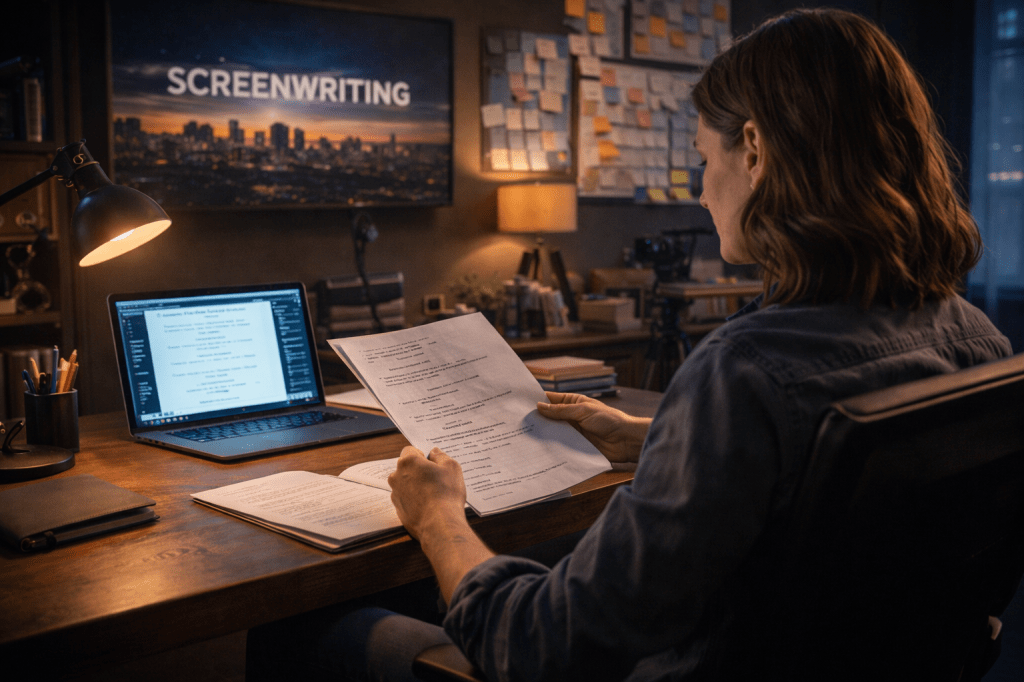
Short films are one of the most experimental ways to convey a story within a limited time. A well-scripted short film can appeal to a global audience. That’s why it required a lot of focus and clarity in storytelling.
Here, I’ve shared the following ten factors that will help you create a powerful short film script. Follow the path and start writing your short film script that resonates with millions.
1. Start with a Clear Idea
A short film cannot handle multiple complex storylines due to its limited duration. Here, writers have less freedom to develop a web, subplots and multiple characters. This is the primary reason why short films are precise and focused.
The best way to start a short film is to focus on one core idea. It can be anything. A moment of realisation. A moral dilemma. A surprising twist. Anything. A short film can be produced in any genre and theme. Be it inspired by personal experience or an external factor. But it should be unique, emotionally gripping and convey a clear message.
When the concept is clear, the audience easily engages with the story and its emotions. This simplicity makes a short film effective.
2. Follow the Show, Don’t Tell technique
As I always say, writers have a great advantage in screenwriting. When you have a screen to show emotions, actions and settings, then why waste time on dialogues? Film is a visual storytelling medium. Instead of explaining, we can use actions and emotions to convey a real message.
Audiences are smart enough to grab the facts through visuals. This is the reason why visuals have become an essential element in short films.
For example, instead of writing “Riya feels lonely,” you can show her sitting alone, looking sad and tired, or with moist eyes, at a birthday party while others laugh and celebrate together.
Through this visual, the writer evokes emotions that instantly resonate with the audience. And when people connect, that becomes a more immersive and memorable experience.
3. Limit Locations
Most short films are created with limited resources. These limitations also applied to its selective locations. But an impactful short film can even be shot in a single location. It thoroughly depends on the way you use visual storytelling.
Trying to add too many locations can make it uneasy to execute the story. To make a story practical, visually appealing and effective, one of the best ways to achieve this is by limiting the number of locations. A writer can use a maximum of 2- 3 locations in their short films. It also allows the story to unfold smoothly without unnecessary shifts in setting. Use the most prominent locations that convey more with their visuals than words.
4. Limit Characters but Develop Strong Character Arcs
The limited time of short films also limits the number of characters. There isn’t enough space to develop multiple complex characters and weave them into a character web.
The fact is, a worthy short film can be shot with a single character. The only thing is that the idea, setup, and central conflict should be very precise. Writers can add up to 2-3 characters in their story. The reason is that there is no time to reveal the long backstory or the brief status quo.
The transformation of each character should be visible in that small duration. The protagonist should have a clear want, obstacles, and a transformation journey. For that, a precise, calculated and researched work is required. A well-developed character, even in a few minutes, can leave a lasting impression on the audience.
5. Introduce the Conflict Quickly
In a short film, you do not have time for long introductions. That’s why it is best if the central conflict appears within the first minute of the story. This placement immediately captures the audience’s attention and provides a reason to stay engaged. Writers can use techniques like the inciting incident and the architect of his own misery.
Keep in mind. Conflict should be very powerful. If there is no strong conflict, there is no tension; without tension, there is no story. Simply, a conflict is a driving force that pushes the narration, characters and world forward. A well-written conflict ensures that the story remains meaningful, engaging and impactful from beginning to end.
6. Follow a Three-Act Structure
Even the shortest films follow a clear and simple structure, known as the three-act structure. This structure helps organise the story in a smooth flow from beginning to end. It is a must-have element in any story because, without a proper structure, a short film or any story can feel confusing or incomplete. This structure becomes beneficial for the audience to easily understand the story.
This three-act structure follows the proper beginning, middle and end. The beginning is the setup that introduces the main character and their situation. The middle is the confrontation, where the problem becomes more intense and challenges the character. Finally, the end, resolution comes where the story concludes with a twist, realisation, or emotional impact. A clear structure ensures that the story feels complete and satisfying.
7. Write Powerful Dialogue
No dialogue is the best dialogue for visual cinema, but it doesn’t mean you are restricted to using dialogue throughout the script. Your first try should be to use the screen and emotions rather than words.
Dialogue in short films should be precise, purposeful, and impactful. There is no space for monologues, speeches or unnecessary conversations.
Every line of dialogue must serve a clear purpose in the story. Should be crisp, short and meaningful. Writers should write them with intelligence and psychologically.
8. End with Impact
The ending is what the audience remembers the most. A short film should always end with a strong impact. It should have a thought-provoking ending that forces viewers to rethink. Conveys a message that stays with viewers.
The goal is not just to conclude the story, but to leave a lasting impression, making the audience feel something deeply even after the film has ended.
The short films also have an open ending. These kinds of endings are very constructive and leave the viewers connected. Writers, if thinking of adding this type of ending, write it smartly.
9. Write In Proper Screenplay Format
Writing a short film in proper screenplay format is essential for clear communication within the film industry. A well-formatted script ensures that directors, actors, and production teams can easily understand the story and visualise how it will appear on screen. Even a powerful idea can lose its impact if it is not presented in a professional format.
Using proper screenplay format also shows professionalism and increases the chances of your script being taken seriously. It helps your work align with industry standards, and also makes it easier for others to collaborate and bring your story to life.
10. Edit and Rewrite Ruthlessly
Rewriting is the real writing, and editing is one of the essential steps in writing short films. After completing the first draft, writers must review their script and remove every element that does not serve the story. It is an economy of words where each word is placed purposefully.
As a writer, everyone is attached to their works. Sometimes, we create scenes that we find very impressive. We do not want to eliminate that from the script, but it never works. Writers need ruthless editing and honesty in their script. Something that doesn’t suit the story, whether it be a dialogue, action or the whole scene, remove that instantly. This discipline ensures that the story remains tight and engaging.
Final Words
Writing a short film is about telling a powerful story with precision and clarity. A strong idea, a focused conflict, and a meaningful ending can turn a simple concept into a memorable cinematic experience.
Your short film script might be the first step toward your storytelling career. If you found this helpful, drop a comment below and share your thoughts or questions. I’d love to hear your perspective.
Also, share this with fellow writers and filmmakers who need it.
Don’t forget to share your feedback. Your every word helps create better content for you.
Simran Thakur
Founder AFAWW
Author| Audio story scriptwriter| Screenwriter| Blogger| Poet










Leave a comment