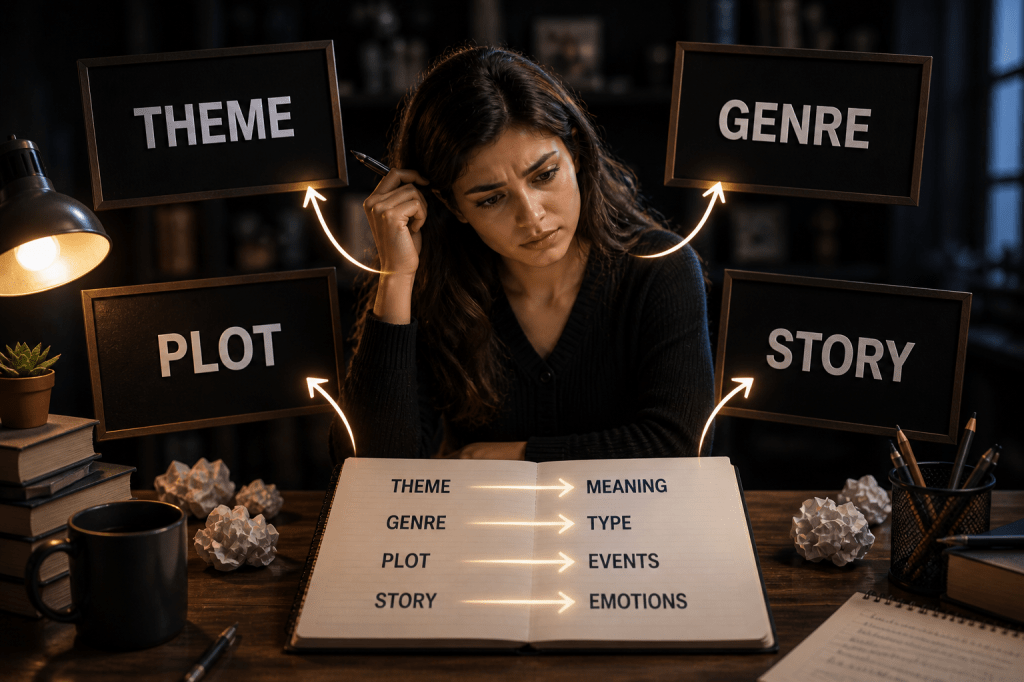
By reading the title, many of you already comprehend what we are going to talk about today. These terms may not be a problem for professional writers, but for beginners, they are among the most confusing terms.
Many beginner writers constantly struggle to understand the basic difference between theme and genre, and plot and story. I was also among them when I was a beginner. I felt these terms were most confusing in my early writing days. But with time and practice, I began to understand the basic difference clearly.
That’s why I’m here with my new blog to clear all your confusion about these topics.
This blog is for beginners. If you are reading this, by the end of this blog, your concepts will become much clearer. Remember that becoming a writer is not just about writing; it’s also about understanding the terms that come with the writing journey.
In this blog, we will discuss about what is meant by a theme. What genre is? Some examples of theme and genre. What is meant by a plot? What is a story? And some examples of plot and story.
Let’s dive into it and master the concepts of storytelling.
Part 1: Theme vs Genre (Explained with Examples!)
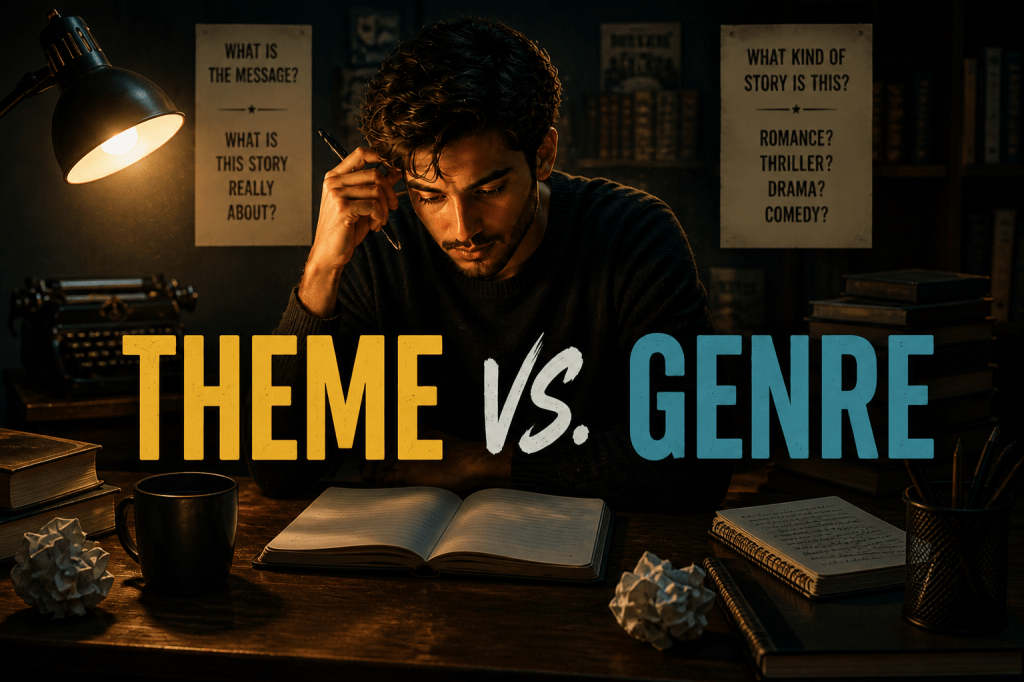
What is Meant by a Theme in Storytelling? A Complete Definition.
The theme is the core message of your story. It is a universal truth or message that can be explored through books, audio stories or movies. It is the answer to a question, “What is this story really about?”
Every story carries a theme. Sometimes it is clearly visible, sometimes it is layered, but always present as a strong message.
For example, A story of two people who fall in love. At first impression, it looks like a romance, but romance is not a theme. The theme could be that love conquers fear, overcomes war and borders, requires sacrifice, or is complicated and imperfect.
The theme can be anything. The same story idea can carry different themes. It depends on how it is written and what the writer wants to express.
Why Does A Theme Matter in Storytelling?
The theme is the universal human experiences and emotions. It should be clear to connect profoundly with audiences. Some themes like truth always finds a way, a journey to self-discovery, and a corrupt system vs. a common man, are most common. People relate to them easily because they show real-life struggles/experiences.
- The theme is a small but essential and strong part of storytelling. It can become an unforgettable experience for the audience.
- The theme should unfold naturally throughout the story. For writers, understanding the theme helps them to make better creative decisions.
- It helps in creating character sketches, preparing a three-act structure and events. The way a story begins and ends is shaped by its theme. In fact, every scene, dialogue, and action revolves around it.
An Example of a Theme.
Suppose a young girl from the slum wants to become a singer, but her family and society constantly discourage her. She experiences rejections, judgments, and self-doubt. Despite obstacles, she continues to practice and finally performs on stage.
Now, tell me, what should be the theme of a story?
Let’s create it together. The theme should be believing in yourself despite fear and rejection. Or, Dreams/courage vs social judgements/pressure. Or, rising above circumstances. Or, break the barrier/societal norms.
In this story, the events will play important roles, but what truly matters is the message that self-belief can overcome failure, which will remain with the audience forever.
What is Meant by Genre in Storytelling? A Complete Definition.
A genre is the category of your story. It tells the audience what kind of experience they can expect throughout the narrative. It answers the question, “What type of story is this?”
For example, if you are writing a thriller, the audience immediately starts expecting suspense, tension, and unpredictability. If you say romance, they expect emotional drama, love, and relationships.
A genre clarifies the tone, style and direction of a story. There are many genres such as romance, thriller, horror, comedy, sci-fi, action, drama and more. Each genre comes with its elements.
For example, Horror aims to frighten. Comedy focuses on humour. Drama explores emotional real situations. These patterns help in guiding both the writer and the audience.
Why Does A Genre Matter in a Story?
When readers or viewers choose a particular genre, they already set a certain mood in mind. If someone chooses a comedy, they expect to laugh. If they select a horror, they expect to feel scared. Meeting these expectations is important for writers.
- Genre helps writers make creative decisions. It directs them on how to add depth to keep things engaging.
- It decides the tone and flow of a story. Guides how scenes are written and how the story moves.
Note: A story can belong to more than one genre. Today, many stories combine genres, such as romantic thriller, action-comedy, or horror drama. This combination allows writers to create unique experiences.
An Example of A Genre.
Suppose a detective is trying to solve a murder case. This case is the toughest and rarest case of his journey. During his investigation, he uncovers many hidden secrets. Some are dangerous, and some are surprising. As he moves further, he races against time to catch the killer.
Now, think. What will be the genre of this story?
Yes. Thriller, Mystery or Suspense thriller.
This example shows that genre defines the type of experience. Once the audience recognises it is a suspense thriller or mystery, they expect unpredictability. That expectation will force them to stay connected throughout the narrative.
Part 2: Plot vs Story (Explained with Examples!)
What is Meant by Plot in Storytelling?
A plot is the carefully arranged sequence of events in a story. It is about what happens in the scene or event with the characters. They are not random events. In fact, everything in storytelling is plotted cleverly by writers. Conflicts, obstacles, actions, stakes, characters, challenges, and more fall into it.
A well-structured plot keeps the audience engaged. It guides the audience, producers, or directors through a step-by-step narration of a story. Once the director understands the plot, it helps them to present and shoot it on the screen.
A plot follows the three-act structure. It has a proper beginning, where the world/status quo is set. The middle is where conflicts, tensions, and stakes are raised. And, the end, where everything feels resolved.
Let’s take an example.
Two college students meet for the first time in the college canteen. Their interaction remains aggressive, but slowly they become friends. They start understanding each other, and their small talk turns into a long conversation. Love tries to surround them, but a misunderstanding separates their journeys. They struggle to resolve their issue, but finally find their true love.
This sequence forms the plot of a romantic story. Here, each event is strategically, smartly, and logically placed. Without a clear plot, a story can feel confusing or directionless.
Why Plot Matters in a Story?
A plot is about progression. It has everything with a purpose. They push the characters into difficult situations and force them to make decisions, which keeps the story dynamic.
- A plot connects events and shows what happens next.
- Creates curiosity that attracts people to reading or watching.
- Provides a clear three-act structure. It diminished the confusion.
- Builds drama and keeps the story progressing and interesting.
- Puts characters in situations where they must act, make decisions, and face consequences.
An Example of A Plot.
A woman receives a mysterious message. Curiosity pulls her in. She starts investigating its source, and clues lead to buried memories. Someone from her past watches her every time. Fear grows, but she continues her search. Finally, she discovers a hidden truth that changes everything.
Now, you can feel the essence of a plot. This sequence of events forms the plot of a mystery or thriller story. You can easily create situations, scenes, dialogues, and actions using this plot. That is the real power of it. It directs the whole narrative in a sequence.
What is Meant by a Story?
A story is the emotional journey behind the events/scenes. It is about how the character reacts to the situation you have created in the plot. The basic difference is that a plot tells us what happens, and a story tells us how to react. Plot is cause, and story is effect or reaction.
A story explains why the characters act this way. About their feelings, struggles, relationships, emotions, morals, and transformation. In simple terms, a story answers the question, “How will a character react to this situation?”
For example, two college students, Meera and Kartik, meet in a canteen. Kartik is a stylish, cool dude, while Meera is simple but confident in her traditional morals. Their first meeting turns into an argument. Both morals stand against each other. Meera talks about traditional ethics, and Kartik about modern thinking. Their clash turns the environment into a serious place.
In this example, you can observe that both characters’ character sketches come between the conversation. They act or react according to their morals and beliefs. That is a story where your character acts in a situation you have plotted before.
Why Story Matters?
A story follows a three-act structure, emotions, and transformation. Emotions connect the audience with the characters. Transformation shows character growth. And a three-act structure gives a story a proper beginning, middle and end.
Without a story, a sequence of events will feel empty. But when emotional depth, actions and consequences are added, those same events become meaningful and impactful. A story,
- Helps the audience connect with the character’s journey.
- Adds depth to the plot and explains why the characters behave this way.
- Adds layers to the narrative that make the narrative more powerful.
People may forget the plot, but they remember how a story made them feel.
An Example of A Story.
It is an example from Drishyam when Vijay’s daughter, Anju, accidentally commits a crime.
Let’s create a story on that scene in our own words. We would write about how a simple man, Vijay, acts in that tense situation.
Story:
Sam misbehaves with Anju and her mother when Anju attacks him and accidentally kills him in panic. She breaks down in fear, but Vijay stays calm. He controls his emotions, consoles his family, and plans every step carefully.
Vijay buries Sam’s body in their garden and starts preparing his family for further police investigation. During this, he maintains a good relationship with everyone. Has a smile on his face. But now, become more concerned and attentive.
In this example, you will see Vijay was a simple and happy man, but a life-changing incident changed everything. The scene was plotted, but his actions and reactions make it more intense and curious to the audience. It pushes the story forward. Shifts the tone, energy and engagement to the next level. That is the power of a story.
Final Thought
Understanding the difference between theme and genre, and plot and story, is the foundation of powerful storytelling. Once you understand these elements clearly, your writing becomes more intentional and meaningful.
Now, it is your turn, writers!
I’d love to hear from you. Comment below and tell me, what was the most confusing concept for you before this?
If you find this blog helpful, share it with your writer friends who are still struggling with these basics.
Don’t forget to share your feedback. Your every word matters to us and helps us create more valuable content for you.
Simran Thakur
Founder and CEO, AFAWW
Author| Audio story scriptwriter| Screenwriter| Blogger| Poet











Leave a comment