Storytelling is one of the oldest human traditions. In ancient times, people had used different forms of storytelling. It can be through oral, music, dance, traditional toys, painting, and carved art to depict their stories. Over time, storytelling evolved as new forms of media emerged. We adapted to the changing ways people share their stories.
Today, we have multiple media through which we can articulate our thoughts, perspectives, and stories(fiction, non-fiction, blogging, newsletters, etc.). But every writing format demands a unique script structure and format.
Whether it becomes a bestselling novel, an engaging audio story, or a blockbuster film, the script is the blueprint. Yet, many writers struggle with structure and clarity that make a script professional, readable, and market-ready.
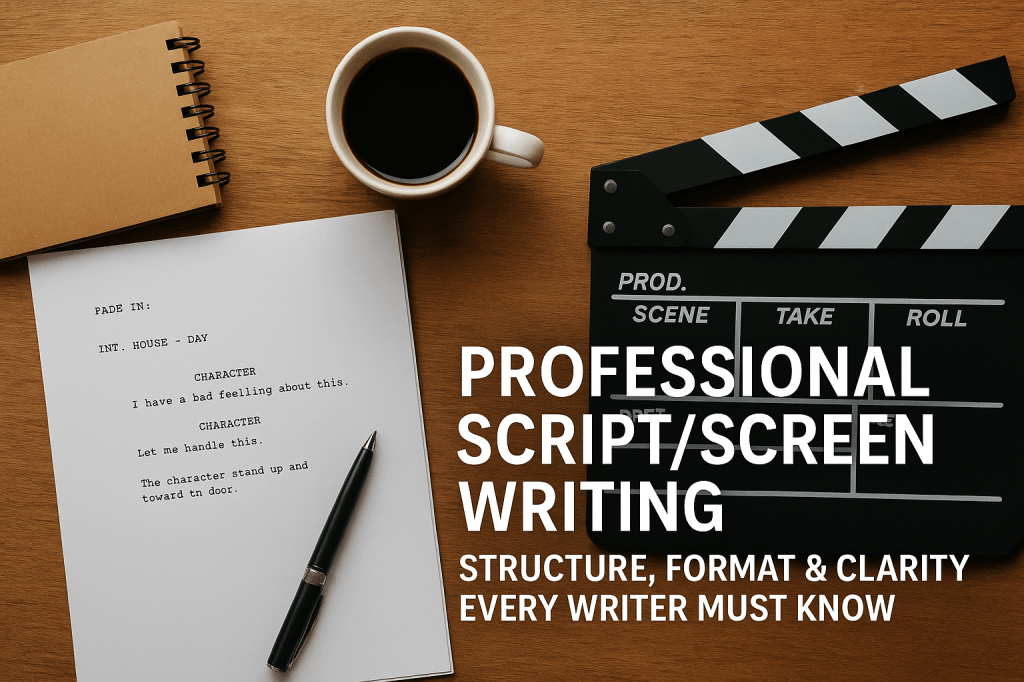
In this blog, we’ll explore multiple assets of a script. We’ll learn what a script is, what is meant by screenwriting and its audience, and the essential steps in screenwriting. Also, will learn some pre-scriptwriting habits every writer should adopt.
Let’s dive into it.
What is a Script?
A script is the foundation that should be strong, structured, clear and precise to bring to life. It is a sharply implemented pathway that a writer creates with a proper 3-Act structure (setup, confrontation, resolution) and techniques. A script outlines the flow of a story. It has properly defined scenes, dialogues, characters, actions, and emotions in an industrial format. It guides directors, producers, and actors on how a story should be experienced by readers, listeners, or viewers.
What is Screenwriting?
Screenwriting is often called a screenplay. It is the craft of writing scripts specifically for films, television shows, or microdramas. It is a unique form of storytelling that is designed for a visual and auditory medium. Here, every line must translate into something filmable on screen.
For example, rather than writing “He felt sad,” a screenplay would show it through imagery. “Tears roll down his cheek as he stares at the empty chair,” Or “A girl is tired and sits alone.”
The primary purpose of a screenplay is to act as a production-ready blueprint. It guides the entire filmmaking process by detailing scenes, actions, and dialogues.
The ultimate audience of the screenplays is the film or television viewers. People love to experience the screenplay’s transformation into a visual narrative on screen. Every person has their interests and expectations to view on screen. It is a writer’s job to prepare a script that is a blend of clarity, uniqueness, and techniques.
Once your idea, techniques, structure, and flow start aligning, your script comes together naturally. A well-crafted script attracts both producers and audience on its own.
How to Write a Script: Step-by-Step Screenwriting Guide
Writing a screenplay requires discipline, clarity, and structure. Here’s the step-by-step approach:
1. Start with an Idea or Research
What excites you? What problem or story do you want to tell? Your idea can come from personal experiences or something you observe in the world around you. Choose the one that connects with you emotionally and deeply, because that passion will keep you motivated.
2. Set Theme and Genre
Theme is the deeper meaning of a story. A message or truth it wants to share, like love, courage, or justice. Genre is the type of story, such as romance, thriller, or comedy. Together, genre shapes the style while theme gives the story purpose and impact.
3. Journal or Brainstorm
Brainstorming is essential because it helps you unlock creativity and prevent your story from feeling one-dimensional. It’s the stage where you give yourself permission to be messy before shaping the final draft. Jot down everything. Your ideas, conflicts, scenes, characters, and what could be the possible beginning, middle, or end to add or remove elements.
4. Develop Characters
To make strong, engaging characters, create layered personalities with inner struggles and external conflicts. Work on their appearances, strengths, flaws, morals, world, and should have an arc. A character should evolve or change by the end of the story. When audiences connect with a character’s journey, they stay emotionally invested.
5. Logline
A two-line summary that captures the essence of your entire story. It must include the protagonist, their want, the inciting incident, the main obstacles/conflict, and a strong hook to intrigue readers or producers. It’s your story’s elevator pitch.
6. Follow the 3-Act structure
Most professional screenplays follow this structure. Act 1 – Setup (25–30 pages): Introduce characters, world, and tone. End with an inciting incident that changes everything. Act 2 – Confrontation (50–60 pages): Rising action, conflicts, midpoint twist. The Protagonist faces failures, challenges, and higher stakes. Act 3 – Resolution (20–30 pages): The climax: ultimate confrontation or revelation. Loose ends are tied, and characters undergo transformation.
7. Plot the Story
Before diving into scenes, outline the beginning, middle, and end of your story(3-Act Structure). A clear plot outline acts as a roadmap. It prevents your story from drifting aimlessly. Strong plotting ensures your screenplay will be focused and impactful.
8. Synopsis or Story
A synopsis is a clear, concise summary of your entire story. It is written in the present tense and third person. A strong synopsis should be engaging, clear, and thematic. It also plays a vital role in writing a script and pitching professionally to production houses. It outlines everything mentioned in 1-7, but with purpose and techniques. Keep it visual, avoiding dialogue, backstory dumps, or camera cues.
9. Write the First Draft
Focus on building your narrative scene by scene with clarity and purpose. Each scene should move the story forward, revealing character, conflict, or raising stakes. Add dialogues that sound natural. At this stage, don’t aim for perfection. Keep it raw and flexible. Remember, the first draft is about discovery; refinement and polishing will come later through rewrites.
10. Revise & Rewrite
True writing begins in rewriting. Rewriting helps sharpen structure, characters, dialogues, and pacing. Each pass makes the script stronger and turns rough ideas into a compelling, production-ready draft.
Follow this sequence, and you’ll never struggle with writer’s block or lose direction. It keeps you clear, focused, and aligned with industry standards. Mastering the right format not only prevents confusion but also comes with the best creative results.
How to Write an Industry Standard Screenplay: Format and Tips
The screenplay isn’t just about story; it’s about professional formatting. The film industry has strict formatting to ensure clarity, consistency, and universal readability for smooth production.

1. Font: Courier 12pt
All professional screenplays use Courier font, size 12. This is the industry standard because it creates uniform spacing and makes the script easy to read. It ensures page length translates correctly to screen time.
2. Page Rule: 1 Page = 1 Minute of Screen Time
Every page of a properly formatted screenplay roughly equals one minute of actual film time.
For example, a 120-page script is expected to become a 2-hour movie. This helps filmmakers, producers, and directors estimate pacing and duration at a glance.
3. Scene Headings (Slug Lines)
Always start a new scene with a scene heading in CAPS. The format is:
INT./EXT. -LOCATION -TIME
Example: INT. COFFEE SHOP – DAY.
- INT. means interior, EXT. means exterior.
- The location specifies where the scene takes place.
- Time is usually DAY or NIGHT.
4. Action Lines
Action lines describe what the audience sees and hears. Keep them short, clear, and visual. Avoid inner thoughts or lengthy descriptions.
Example: Manish slams a cup on the counter. Coffer spills over the edge.
5. Character Names
When a character speaks, their name is centered and in CAPS before their dialogue. This makes it easy for actors to identify their lines.
6. Dialogue
Written directly below the character’s name, also centered. Keep it natural, short, and aligned with how people actually speak.
Example:
MANISH
I can’t believe you did that.
7. Parentheticals
Used sparingly to indicate tone, intention, or action within dialogue.
Example:
MANISH
(Sarcastic)
Yeah, that was brilliant.
Overusing parentheticals can clutter the page, so use only when clarity is needed.
8. Transitions
Placed on the far right side of the page, transitions guide how scenes shift.
Common ones include CUT TO:, FADE IN:, FADE OUT:, DISSOLVE TO:.
A script with messy or inconsistent formatting immediately signals unprofessional. Even if your story is strong, poor formatting can make professionals dismiss your work before they even dive into the content. On the other hand, clean formatting instantly builds credibility. It shows you understand industry expectations and respect the time of those reading your script.
Length Guidelines
- Feature Film: 90–120 pages
Most films fall within this range, translating to 90–120 minutes of screen time. Anything too short or too long raises concerns about pacing, budget, and audience engagement. - TV Drama: 45–60 pages
Drama episodes, typically an hour long with ad breaks, usually fall within this range. Sticking to it helps networks and producers schedule programming efficiently. - Web Series: 20–50 pages per episode
Web episodes range widely depending on the platform. Some demands are short and experimental scripts, others as structured as TV dramas. The key is consistent episode length to keep audiences engaged. - Short Film: 1–40 pages
Short films follow the same “1 page = 1 minute” rule, but within a much tighter frame. This demands efficient storytelling, often focusing on one idea, moment, or twist. - Reel / Micro-Script: (~3 pages)
Scripts for Instagram Reels, YouTube Shorts, or TikTok are brief but require sharp clarity. These scripts often rely on snappy dialogue, quick actions, or a single visual punchline to grab attention.
Note: All screenwriting scripts follow the same structure and format.
Why it Matters: These formatting rules ensure your script is professional, readable, and production-friendly. Producers, directors, and agents often read dozens of scripts a week. So, a well-formatted script isn’t just easier to read, it increases your chances of being taken seriously.
Note: Highly recommended tools for Screenwriting: Final Draft, Celtx, Fade In, Scrite, and WriterDuet.
Script Submission Essentials that Writers Need to Submit to Production Houses
Before pitching, a writer must submit a well-structured logline and synopsis that clearly conveys the story, characters, and stakes. To protect intellectual property, these documents should be registered with a recognised association such as the Screenwriters Association (SWA) or similar. It ensures copyright protection and credibility during the pitching process.
If the response to your initial submission is positive, the production house usually requests a pitch deck or related documentation. This includes the logline, plot outline, tentative locations, brief synopsis, and character sketch.
After the pitch deck stage, the process moves to narrating the story in detail, followed by the final script submission. Below is a small gist of a pitch deck.
Pitch Deck / Presentation (Optional or as per Demand)
A pitch deck is a short and visual presentation that highlights your story, target audience, and unique selling point. It’s designed to be persuasive and easy to help producers or investors make quick decisions. Keep it concise, engaging, and focused on what makes your project stand out. It includes,
1. Logline: A one-sentence summary of your story. It should clearly convey the main conflict, protagonist, and stakes. Don’t reveal the end.
2. Synopsis: A 1–2 page summary of your story. Covers main plot points, characters, and story arc. Keep it concise but compelling.
3. Treatment or 10-pager: A 5–10 page document giving a more detailed narrative. Includes key scenes, character development, tone, and style. Often used for TV series or films to convey the story’s feel and pacing.
4. Character Sketch: Detailed profiles of main and supporting characters. Includes traits, backstory, relationships, morals, and motivations. Helps producers quickly understand character depth and arcs.
5. CV / Portfolio (Optional but Strongly Recommended): Your previous work, awards, or relevant experience. Shows credibility and professionalism.
Note: Keep documents concise, clean, and formatted professionally. Have digital (PDF) versions ready; print versions are optional. Email with a summary and why your story fits their slate, with attached documents.
Final Words
Start small, write consistently, and let your ideas evolve into scripts that capture hearts and minds. A script is more than just words. It’s the skeleton of your story. The guiding map that brings imagination into reality. A professional screenplay combines creative storytelling with technical precision. Whether you’re writing for a short film or a web series, remember: the clearer your script, the louder your story speaks.
Before you dive into your next script, remember: prepare, structure, and rewrite. Every great screenplay, novel, or audio story began as a messy draft that became extraordinary through persistence and clarity.
So grab your journal, brainstorm freely, write your logline, and let your story unfold—one script page at a time.
Now it’s your turn!
I’d love to hear from you. Drop a comment with your thoughts, share your feedback, or tell us about your own screenwriting journey. Do you have formatting tips, tools, or tricks that work for you?
Let’s make this a space where writers learn from each other.
And if you found this guide helpful, don’t forget to share it with fellow storytellers who are on the same path.
I’m waiting for your valuable feedback. Your every word matters to us.
Simran Thakur
Founder AFAWW
Author| Audio Story Scriptwriter| Blogger| Poet












Leave a comment