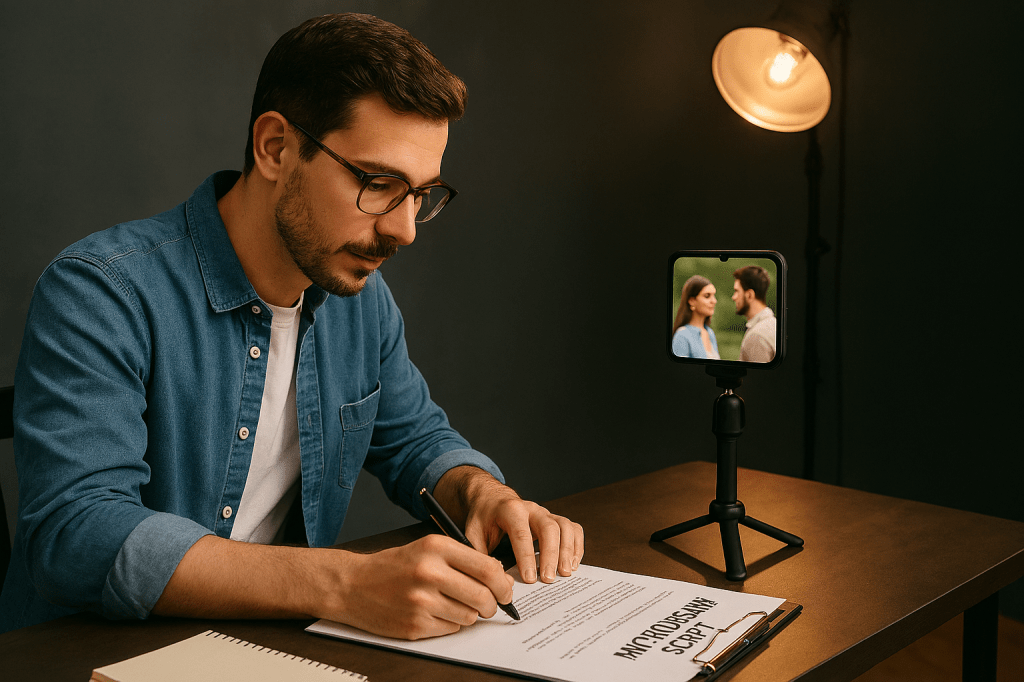
Multiple studies have consistently proven that the attention span of humans is decreasing in the digital world. In fact, a report by Microsoft (2015) indicated that the average human attention span dropped from 12 seconds in 2000 to around 8 seconds in 2013.
Noticing this behavioural change, China first launched the micro drama series. These professionally written series were divided into short episodes of 2-3 minutes. Designed for vertical screens to be more addictive, so that people would be curious to see the next episode.
It was an experiment in the screenwriting world, but soon it got attention and became the most-well-viewed series. With that, these microdrama series started booming in the screenwriting industry. People started experiencing the vertical cinema and crossed tens of millions of views by watching these series.
To observe the change, many more studios, including India, have launched their microdrama apps. These apps are now successfully reaching millions of views and are consistently demanding new writers and fresh concepts for their microdrama apps.
So, if you’re a screenwriter and want to make a career in the microdrama world, this blog is for you.
In this blog, I’ll share what microdrama is. Why microdrama is evolving so quickly. Difference between short films and micro dramas. And some must-have elements writers should remember while writing a microdrama script.
Let’s dive into it.
What Is a Micro Drama?
Micro dramas are professionally scripted series that have numerous episodes, each lasting 2-3 minutes(60-180 seconds). Here, each episode focused on one strong emotional conflict, engaging hook and ends on a proper cliffhanger. Primarily designed to appeal to the audience so that they will be curious to know what will happen in the next episode.
These microdrama series are primarily built for vertical/mobile screens, where most people watch content today. It is neither a short film nor a mass cinema. It keeps the audience engaged with its simple and beautiful storytelling, which emotionally impacts people in small time.
Micro drama delivers fast-paced storytelling packed with scripted twists, conflicts, and emotions. In fact, it also follows the proper 3-Act structure, which means beginning (setup), middle (confrontation) and end (resolution). Also, follows industry-standard scriptwriting format and structure.
Why Micro Dramas Are Evolving So Quickly
- Due to the large consumption of mobile and other digital media, nowadays, a huge number of stories/microdramas are created for mobile users and are frequently consumed by them.
- Microdrama fits perfectly into this mobile-first ecosystem. It is short, intense and designed especially for vertical screens for quick consumption.
- Mobile users naturally prefer short, emotionally engaging stories that can be watched during small breaks in their day.
- Another factor is that the production cost of microdramas is much lower than that of traditional films or web series.
- Its content can be written, produced, and released quickly. This allows writers and filmmakers to experiment with ideas without risking huge budgets.
Difference Between Short Films and Micro Dramas
A short film and a microdrama both follow the Three-Act structure and other industry standards, but with different purposes and formats. Their aims are different and their target audience too.
Short Film
- A short film typically ranges from 5 to 30 minutes or even more.
- It has more time to build the setup, explore characters, and multiple layers.
- It is not segmented into episodes and does not focus only on vertical screens.
- It may or may not have an open ending, but it does not have a cliffhanger in the end.
- Short films are usually created for film festivals, streaming platforms, or theatrical showcases.
Micro Drama
- A microdrama’s episodes usually range from 1 to 3 minutes.
- It is fast-paced stories that focus on the core conflict per episode.
- Microdramas are divided into episodes and are highly focused on vertical screens.
- Here, episodes end on a cliffhanger, so the audience is eager to know what next.
- Microdramas are primarily designed for mobile platforms, where attention spans are shorter.
Some Essential Elements That Should Be a Part of a Powerful Micro Drama Script

The screenwriting world is no longer limited to films, television, or OTT platforms. As audience behaviour shifts toward mobile-first consumption, viewers now expect more entertainment in shorter time frames.
In this environment, microdrama has emerged as one of the most powerful and practical storytelling formats.
Today’s audiences demand stories that hook them instantly and maintain a pace throughout. In that case, writers have the opportunity to prepare a beautifully written microdrama that connects people.
For that, they should remember some essential points before scripting their microdrama series.
1. Microdrama Structure Formula
A strong microdrama consists of short episodes, but with a clear structure. Here is the simple and effective formula that can help maintain the natural flow of a series while keeping the pacing tight.
- Start with a powerful hook in the first 0–5 seconds. This is where you grab attention with conflict, tension, or an inciting incident.
- Next, between 5 and 20 seconds, clearly introduce the setup and main character.
- From 20 to 60 seconds, build emotional engagement. Increase tension, deepen reactions, and move toward confrontation.
- Then move to increase the stakes so the audience understands what is at stake.
- Finally, in the last 10 seconds, deliver the twist. End with an impactful cliffhanger.
2. Length Matters
In microdrama, length is one of the most important elements. Here, the ideal duration of episodes usually falls from 60 to 180 seconds. In that case, writers should respect the audience’s limited attention spans.
A well-written microdrama is one where pacing must be tight and purposeful, which can leave a strong emotional impact and a memorable ending on its audience.
3. Write for the Screen (Vertical Screen)
Microdramas are identical to other screenwriting projects, which are highly focused on visuals, expressions, close-ups and setups. Techniques such as breadcrumbing, show, don’t tell, and others are also used here. Their audience and format may differ from others, but it also demands high visual storytelling.
Microdramas are primarily focused on vertical screens, a point writers should remember. Writers should focus on sharp visual narratives for vertical cinema. The script should naturally support strong facial expressions, body language and setups that cover vertically.
Always keep in mind that one powerful look can replace five lines of dialogue.
4. Follow the Three-Act Structure
Microdramas are not different from the screenwriting world; it is a part of it. It follows every professional standard that is important in the screenwriting world. May it be logline preparation, synopsis, inciting incidents, techniques, plots, character sketches, three-act structure, scenes, world-building or screenwriting tools.
Their scripting also follows professional screenwriting standards. This structure gives the story direction and emotional flow. Following these, even a 60–180 second microdrama feels complete and satisfying.
5. Start With a Strong Hook (First 3–5 Seconds)
The first three to five seconds are critical for any microdrama. That is when the audience decides whether to keep watching or scroll away. There is no time for slow introductions or casual greetings.
The story must begin with conflict, tension, or an intriguing question. Instead of starting with something flat. This hook immediately creates curiosity and drama that force the audience to stay.
In microdrama, the hook is the survival point of the entire story.
6. Focus on One Core Conflict
Take one step at a time. There is no space for subplots or side stories in microdramas. The limited duration demands complete focus on a central conflict.
Choose a single emotional problem, one strong confrontation, or one powerful revelation and build the entire story around it. Microdrama works best when it goes deep rather than wide. So, concentrate on emotional intensity. When the conflict is clear and focused, it engages the audience emotionally.
7. Create Consistent Emotional Engagement
In microdrama, emotion cannot build slowly; it must escalate quickly. Since the duration is short, the audience needs to feel the intensity almost immediately.
Use sharp, strong facial expressions to reveal pain, anger, shock, or love. Strategic pauses create tension and allow the moment to breathe.
Always remember, emotion is more powerful than description. In microdrama, what the audience feels matters far more than what is explained.
8. Minimal Characters With Complete Character Arcs
Adding many characters never makes a story worthy, but finely created characters are. Use fewer characters in your microdrama. Writers should take time to create every character sketch with a proper character arc.
Here, the time is limited. The screen is limited. But efforts and pacing should not be limited. Ideally, a microdrama should include only one to three characters. Each character must represent a perspective in the story. Their motivation should be clear and immediate, so the audience understands why they act or react in a certain way.
9. Keep Dialogues Short & Punchy
Don’t waste time on dialogues if not needed. Microdramas are vertical cinema where writers have an advantage to show actions and expressions without wasting a word. Use that advantage, writers.
Make the “show, don’t tell” technique their priority. This helps to make every dialogue sharp and purposeful. There is no room for monologues or long speeches. Every line should move the story forward or deepen the emotional tension. Microdrama dialogue works best when it is direct, natural, and expresses emotions.
10 End Each Episode With a Cliffhanger
Microdramas are prepared to keep the audience engaged. People will watch the content and go back to see the next one. For that, every episode must end on a cliffhanger. This cliffhanger enhances the curiosity, and that curiosity forces the audience to stick with their vertical screens.
Microdramas are based on short episodes, which is their real power. The audience feels they will find their answers in the next few seconds. And that eagerness keeps them engaged with the content.
End the episode at a moment of shock or an unanswered question. Do not resolve everything too quickly. Leave something hanging.
Final Words
Microdramas are a new revolution in the screenwriting industry. It is also a new revolution for writers. It is making a tremendous space in the screenwriting world that can’t be ignored.
Accept it or not, in today’s mobile-first world, stories need to be fast, emotional, and visually engaging. If you can master writing a microdrama, you not only sharpen your storytelling skills but also open doors to industry opportunities.
The best way to understand the power of microdrama is to write one yourself. Challenge yourself to create a complete story in 60–90 seconds. Focus on one conflict, one emotional shift, and one strong ending.
If you are serious about becoming an industry-ready screenwriter, start experimenting with microdrama today.
Now, it’s your turn, screenwriters!
We’d love to hear your experiences! Have you tried writing a microdrama yet? What challenges or discoveries did you face while creating one?
Share your thoughts in the comments, and don’t forget to share this guide with fellow writers. Your next big opportunity might start with just one powerful minute.
Also, share your invaluable feedback. It helps us create more valuable content for storytellers like you!
I have also attached a link to the Micro Drama Scriptwriting Workbook and Worksheets. Writers can buy their own workbook using the link and start creating their own industry-ready micro drama.
Simran Thakur
Founder AFAWW
Author| Audio story scriptwriter| Screenwriter| Blogger| Poet











Leave a comment