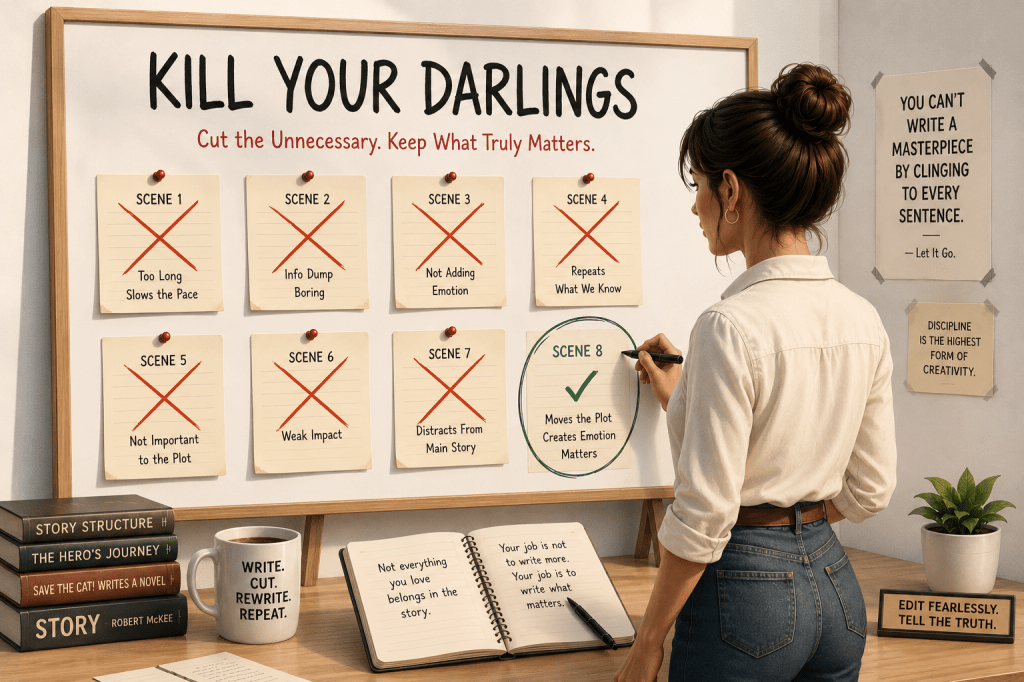
How do you feel when someone says to delete your favourite scene, dialogue or character from a story? What is your reaction as a writer when you get suggestions to change or revise the whole character arc, setting or script?
It sounds irritating, right?
I know it is. As a writer, we love what we write. All words come from our imagination, and we feel they are all worthy and magical. But what if I told you that making a change or deleting something that doesn’t fit your story isn’t a curse at all? In fact, it could be the most valuable decision you make for your magnum opus.
A writer dedicates their time to researching, creating, and arranging all elements in powerful storytelling. Sometimes they create a beautiful, poetic paragraph for their novel. Sometimes, create engaging monologues and character sketches in their screenplay. And sometimes the best descriptive scene is for an audio story script.
But then comes the painful truth.
Maybe that scene, character or dialogue somehow slows or affects the entire story. At that time, writers get a suggestion to use the hardest writing technique, called “Kill Your Darlings.”
Today, we’ll cover everything about the Kill Your Darlings technique. Why does it matter in storytelling? Some psychological reasons why writers stick with their words and learn to overcome them. And at last, how to use this technique in a worthy way to create a magnum opus.
Let’s dive into it.
What is Meant by “Kill Your Darlings” Technique?
Kill Your Darlings is one of the most famous and challenging writing techniques where writers remove all their loving elements that technically don’t serve the story. These elements can be a scene, dialogue, description, action, character, setting, or structure.
This is the most challenging technique for writers because “darlings” are often the lines writers feel proud of. They feel personally attached to work because it sounds more poetic, intelligent, emotional, or creative. However, a beautifully written scene can also have weak pacing, repeat information, or divert the story from the core narrative.
Usually, writers struggle with this technique because they don’t want to remove words that they spent their days or weeks on. But professional storytelling requires discipline and honesty. And Kill Your Darling guides the same.
This technique teaches writers to prioritise the story over personal attachment. It teaches discipline, detachment and storytelling rules. Kill Your Darlings is not about destroying creativity or emotions; it is about what genuinely improves the writing and the reader’s experience.
Why Kill Your Darlings Matters In Every Storytelling Format
Good storytelling is not about showing everything you can write. It is about knowing what deserves to stay in your content. Most beginner writers misunderstand this concept. Some are afraid to cut the unnecessary part, and others cut every creative idea in the name of tight storytelling. But the real meaning of “Kill Your Darlings” is write for your story to make it natural.
I know, writers try to share everything they have researched, written, or know, but the audience only wants a story to feel and experience. They don’t want to delve into how many hours you worked. How much do you know? How many days have you researched? They want perfect final content. Whether it is a novel, an audiobook, a screenplay, or a blog, the audience demands precise, informative, entertaining, and gripping content. That’s why the Kill Your Darlings technique works on every writing format.
See, writing is also a psychological field, where scenes, dialogue and characters are all prepared to engage the audience psychologically. And for that, your content should have calculated information, emotions and writing elements. Otherwise, information will be overloaded and confuse the audience. Result, they will lose interest in your words.
Believe me, when writers remove undeserved elements, they improve pacing, emotional impact, scene consistency, tension and stakes, and natural flow. This technique helps writers make psychologically gripping, attractive content full of the right information. It will organically attract the audience because it saves time, adds authenticity, credibility, and professionalism.
Why Writers Become Emotionally Attached to Their Work and How to Overcome That.
What the audience has read, listened to, or viewed in one go has been created by a writer in weeks, months or even years. This is a long time during which a writer experiences every moment of their story in their mind. They feel attached emotionally to these moments.
- They create plots, scenes, dialogue, and characters with their research and emotional attachment.
- They put their sleepless nights, personal memories, effort, research, and time. And finally structured them all into a fine storytelling format, following industry standards. Their work becomes a part of them. This is why deleting it hurts.
- One of the biggest reasons to attach their work is fear. Fear of wasting effort. Fear of losing creativity. Fear of deleting something irreplaceable.
- Their artistic intelligence turns in beautiful writing, even when those scenes weaken the overall storytelling.
How Writers Can Overcome Personal Attachment to Their Content?
Many beginner writers believe that cutting scenes means failure. But professional writers understand that editing is part of writing. And here, Kill Your Darling comes with its essential role.
Every great novel, screenplay, and audio script goes through painful edits. The elements removed from a story are not always bad. Sometimes they are simply unnecessary.
When you cut a scene, you are not killing your creativity. You are refining the experience for the audience. Let’s take some steps to reduce your insecurities while using Kill Your Darlings.
- Remind yourself every time that you are writing for your audience, for your story.
- Editing, rewriting and reshaping are essential to every storytelling. It strengthens clarity, storytelling quality, and overall narrative for readers.
- Save every deleted scene, dialogue, plot and more in separate folders. Remember that no idea is bad; only work for the perfect place. Maybe the same idea can return in another project.
- Take a break before editing so emotions settle, and you can evaluate scenes more logically.
- Take honest feedback that will help you to check the authenticity of a story more profoundly and focus on the story, not on ego.
How to Use the “Kill Your Darlings” Technique in a Worthy Way
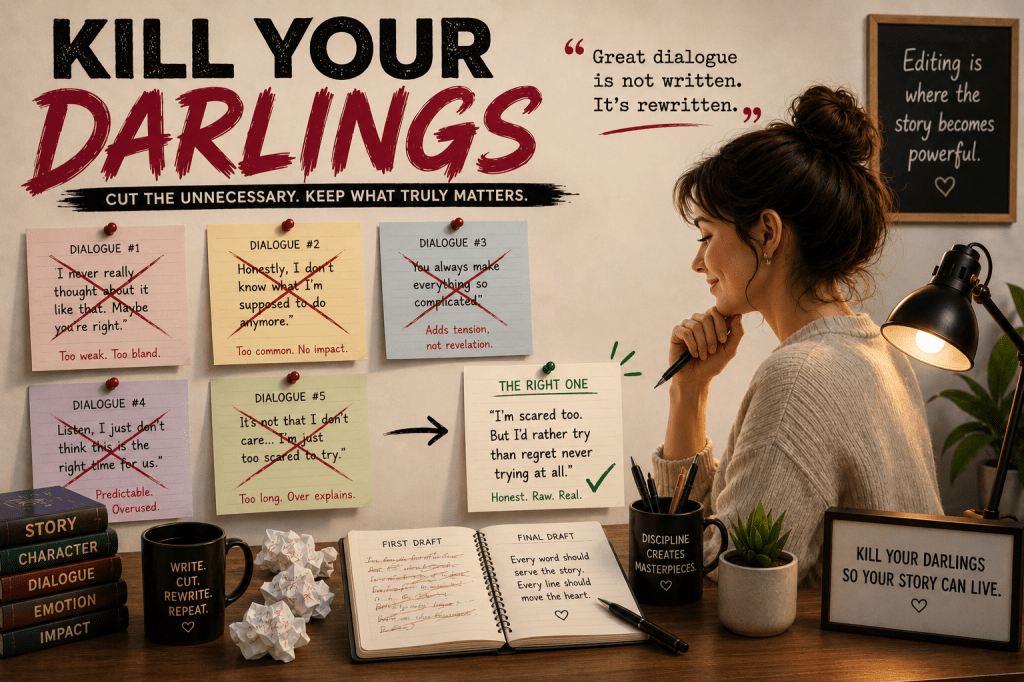
The best way to use “Kill Your Darlings” is with knowledge, not fear. Treat it as a tool for clarity. Ask yourself consistently while creating content:
- Does this element serve the story?
- Does it improve pacing, character, scene, plot or the audience’s experience?
Note: You do not need to delete everything permanently. Save it for later use.
Here are ten important ways writers can use the Kill Your Darlings technique meaningfully without losing their original voice.
1. Prioritise the story above personal attachment.
Professional writers focus on what benefits the story most. They don’t protect scenes simply because they personally love them; they protect them if they find them worthy for the natural flow of a script. Remind yourself that your story is for their audience, and they matter most.
2. Understand the difference between beautiful and necessary.
Not every dialogue, monologue, description or scene deserves to stay. Identify whether a scene creates genuine space or only exists to showcase writing ability.
3. Remove every element that unnecessarily slows pacing.
If a scene repeats information or interrupts natural momentum, it may need editing or removal. Readers experience stories differently from writers. Tight pacing keeps audiences emotionally invested and strengthens overall storytelling.
4. Save deleted content in a separate document.
Kill your darlings does not mean permanently deleting creative ideas. Store removed scenes, dialogue, descriptions, or character concepts in another file. Later, reuse those ideas in different projects. This habit reduces fear and helps writers edit more confidently.
5. Do not remove every emotional depth unnecessarily.
Many beginners misunderstand and remove every emotional or slow moment from their stories. Always remember that calculated emotional silence and atmosphere make stories memorable. The goal is a balance. Once it is clear, the narrative will automatically be clear for the audience.
6. Use feedback to identify Self-Indulgent Writing.
Take genuine help from readers, editors, and mentors. They can often identify unnecessary scenes more easily because they are emotionally detached from the work. If multiple readers feel confused during the same section, it may indicate a “darling” that weakens the story.
7. Apply the technique across every storytelling format.
Kill Your Darlings is useful in novels, screenplays, podcasts, audio stories, and digital content. Every storytelling format requires clarity, pacing, and emotion. The discipline is becoming as valuable as creativity and original ideas.
8. Edit With Long-Term Story Vision
Evaluate content based on the complete story. A scene may feel powerful at the beginning, but it can weaken the narrative structure overall. Don’t create elements for alone use. Looking at the bigger picture helps to decide whether a moment contributes to the consistency of the entire storytelling.
9. Use the Technique to Strengthen Character, Plot, Scenes and more
Use Kill Your Darlings freely to enhance your storytelling. Try to use it in every scene, dialogue, plot, character, description and more. Using this technique, writers focus on meaningful progression. It is a master of all writing techniques.
10. Accept That Great Writing Requires Sacrifice
Revision and rewrite are the prominent parts of every storytelling format. This process teaches writers emotional discipline, honesty, and to write worthily. Add these elements to “Kill Your Darlings” and create a masterpiece for the audience.
Final Words
Writing is all about creating worthy content for a script. For that, writers consistently need to learn the art of letting go (removing weaker sections) for stronger storytelling. Here, the hardest, but powerful writing technique, “Kill Your Darlings”, works for you. It teaches you writing discipline, economy of words, honesty, clarity, and creative maturity. That ultimately helps stories connect more deeply with the audience.
Now, it is your turn, writers!
I hope you enjoyed this blog. Now, answer me in the comments,
Have you ever removed a scene, dialogue, or character you deeply loved while writing? In which writing format have you used the “Kill Your Darlings” technique?
If you found this helpful, feel free to share this blog with fellow writers, storytellers, screenwriters, and creators who want to improve their storytelling skills.
I’ve also attached my:
You can also grab all three workbooks together or purchase them separately according to your writing goals.
Also, don’t forget to share your feedback. Your every word matters to us and helps us to grow as a better writing community.
Keep learning, keep writing.
Simran Thakur
Founder and CEO, AFAWW
Author| Audio story scriptwriter| Screenwriter| Blogger| Poet















Leave a Reply