Writing a book is a remarkable achievement. Every author dreams of seeing their book reach readers. However, once the manuscript is completed, the author faces a crucial question: which publishing path will be beneficial for a long-term writing career?
It is a crucial decision that can impact an author’s earnings, reach, creative control and long-term growth. And that’s why authors usually struggle to make the decision.
Today, authors have more publishing opportunities. The rise of digital platforms in the modern era has changed the publishing industry with self-publishing and print-on-demand technology.
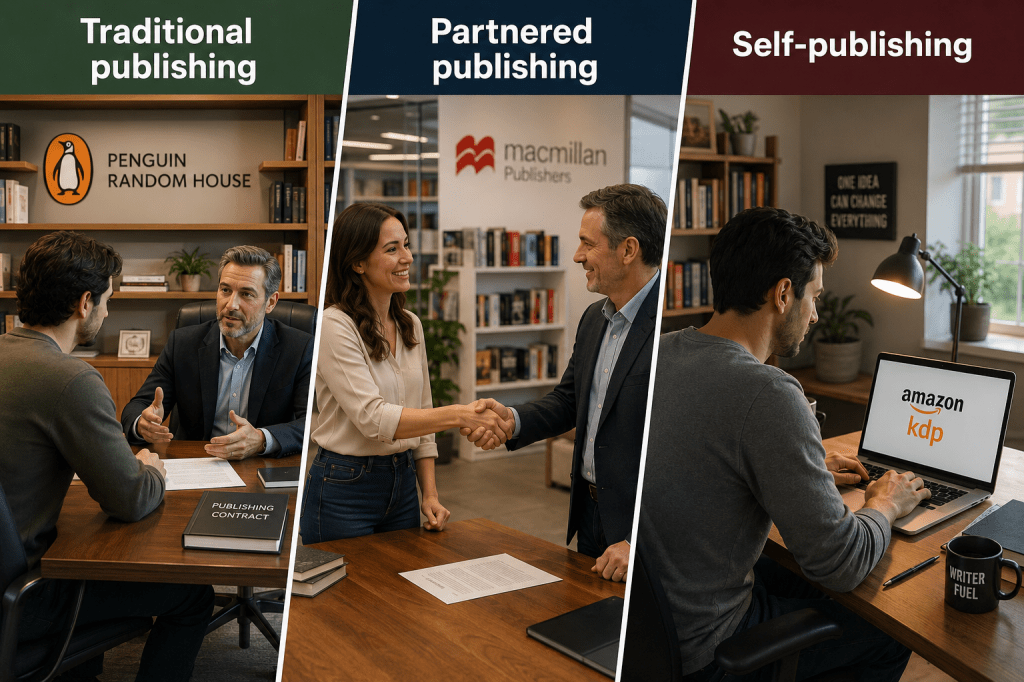
Now, authors have three major options: Traditional publishing, partnered (Hybrid/Assisted) publishing and self-publishing. Each comes with different grades of control, investment, technical assistance and earning potential. Each has its advantages and disadvantages. Authors must have the right knowledge of these publishing paths to achieve their goals and timelines.
In this blog, you will explore all three major paths of publishing with royalty, publishing period, charges, merits and demerits. It will surely help you determine which option best suits your needs.
Let’s dive into it.
First, Understand The Importance of Choosing the Right Publishing Path.
Many writers spend months or even years completing their manuscript, but spend less time understanding the publishing options. As a result, they mistakenly choose a publishing route that will not suit their final goal. Their incomplete information harms their expectations, and manuscript publishing takes longer than expected.
Your publishing choice influences:
- The money you earn per book sold. Different publishing models offer different royalty structures. Understanding your potential income is essential when choosing a publishing path.
- Creative control you retain. Your publishing route determines the authority you have over your book’s title, cover design, pricing, content, and release strategy. It depends on the publishing route and publishing houses.
- Publishing timelines. Traditional publishing takes months or years, whereas self-publishing can make your book available within days. Your choice affects how soon readers will access your work.
- The professional support you receive. Editing, cover design, formatting, distribution, and marketing assistance differ across publishing models.
- Author branding. The publishing model can influence your credibility, visibility, audience growth, and professional reputation. It shapes how readers, professionals, and future publishing opportunities perceive your author brand.
Note: Before signing any contract or uploading your manuscript online, first briefly understand and review the publishing model.
Self-Publishing vs Partner Publishing vs Traditional Publishing: How to Choose the Right Publishing Path.
1. Traditional Publishing
Traditional publishing is the oldest and most recognisable route in the publishing industry. In this model, authors sign a contract with a reputable publishing house. After that, the publisher acquires the right to publish the manuscript and handles production, distribution and publishing expenses.
Roughly, you can say that the publishers have full control of editing, cover design, formatting, printing, and marketing. Many authors dream of seeing their book published by a respected publishing house. Yet it is a popular publishing route.
Who Should Choose Traditional Publishing?
Traditional publishing is ideal for:
- Authors who are debuting in the writing world or are already established authors.
- Seeking industry recognition. Want bookstore distribution.
- Prefer professional guidance and can wait for a longer publication timeline.
How Traditional Publishing Works.
The process begins with submitting the manuscript to a publisher or literary agent. If they accept your manuscript, share a publishing contract with the authors.
Here’s how the money flows:
- Advance Payment: Depending on the author’s profile, genre, and publisher, the author receives a small amount to pay before publishing the book. Some publishers offer this support as a free service. That makes it an attractive path for writers who do not want to invest a huge amount before publishing.
- Royalties: Most traditional publishing contracts offer approximately 10%–20% royalty on the book’s Maximum Retail Price (MRP). It is based on every book sold.
For example: If your book sells for ₹300 and your royalty rate is 10%, you earn:
₹300 × 10% = ₹30 per copy sold.
Traditional publishers help your book reach a larger audience through established distribution channels and physical stores. - Subsidiary rights: Another benefit of traditional publishing is access to subsidiary rights income. If your book is adapted into a film or web series, translated into another language or converted into an audiobook, the author earns additional income depending on the contract terms.
Note: For successful books, subsidiary rights can become a significant revenue stream.
Advantages of Traditional Publishing.
- Authors selected by reputable publishers increase their credibility in the professional writing world. Many readers, bookstores, and media find this publishing model more credible.
- Get access to established bookstores, distributors, libraries, and online retailers that increase the book’s visibility.
- The least expensive or mostly free option is best for debut authors.
- Authors benefit from experienced editors, designers, proofreaders, and publishing professionals.
- In most cases, the publisher covers production and distribution expenses.
Disadvantages of Traditional Publishing.
- One of the biggest demerits of traditional publishing is its publishing timelines. It can extend from months to even one to two years.
- Authors earn the least royalties compared to self and partner publishing.
- Reduce creative control. Publishers may influence cover design, pricing, book title, marketing strategy and more.
- Due to high demand, it is a competitive publishing model. Authors struggle for years to get selected.
- Authors can struggle to establish their presence if they have no large reader base.
2. Partnered Publishing
Partner publishing is a hybrid or assisted publishing that combines author investment with professional publishing support. Simply put, in this model, authors share the publishing costs but retain a higher share of the earnings.
This publishing option is popular among authors with a high budget. It is a rapid process; authors don’t need to wait for years. This publishing model also provides continuous assistance during the publishing process.
Who Should Choose Partner Publishing?
Partner publishing is best suited for:
- Authors are ready to invest in their book.
- Want professional support during the whole publishing process.
- Need a faster publishing timeline with more creative control.
How Partner Publishing Works
The author invests money in publishing services. The publisher helps with editing, cover design, formatting, ISBN and distribution. The investment amount can vary widely depending on the publisher and their fame in the publishing market.
Here’s how the money flows:
1. Upfront Investment: Typically, costs range from ₹15,000 to ₹80,000 or more. Completely depends on the publisher and the services included.
2. Royalties: Because the author contributes financially, royalty rates are much higher than traditional publishing. Many partner publishers offer 30%–70% of profits.
For example, Book selling price: ₹300. Production and distribution costs: ₹120. Profit: ₹180
If your royalty share is:
- 50% = ₹90 per sale
- 70% = ₹126 per sale. This can immensely increase the earning potential.
Advantages of Partner Publishing
- The biggest advantage is that most partner publishers release a book within a few months. The authors save themselves from the years of waiting.
- Authors earn more royalties per copy sold compared to traditional publishing.
- Receive continuous support and guidance from publishing professionals without managing every technical detail themselves.
- Authors retain greater control over cover design, interior formatting, book title and more.
- Gets better production quality for your book.
Disadvantages of Partner Publishing
- The biggest drawback is the upfront cost. There is no guarantee that book sales will recover your investment. It will always remain a high financial risk.
- Many partner publishers primarily focus on production and distribution rather than marketing.
- Authors still need to build their audience themselves and promote their books.
- Not all partner publishers provide equal value. Writers should carefully research: reviews, previous publications, service quality and contract terms before committing.
- Books may be available online, but they still struggle to reach major bookstores or international markets.
3. Self-Publishing
Self-publishing has transformed the entire publishing industry. It gives authors complete freedom to publish and control every aspect of their book themselves. In fact, the U.S. self-publishing market alone is valued at $3.9 billion, which shows the growing power of independent authors.
In self-publishing, the author takes complete responsibility for the book. From the book title, cover design, interior formatting, to marketing and sales, it is entirely in the author’s hands. When, where and how the manuscript will become a book is completely decided by the authors.
Today, many bestselling authors and entrepreneurs are choosing self-publishing because of its flexibility and highest earning potential.
Who Should Choose Self-Publishing?
Self-publishing is ideal for:
- Authors who already have a strong reader base. And wants to build a personal brand.
- Want maximum creative control for their book with the fastest publication.
- Already have marketing skills and experience in book formatting and selling.
How Self-Publishing Works.
Authors publish directly through self-publishing platforms, such as Amazon KDP, Notionpress, Kobo Writing Life, Draft2Digital, etc. These platforms give a global stage to authors and allow writers to publish without needing approval. Also, their print-on-demand services save authors from paying extra money on inventory.
Here’s how the money flows:
- Royalties: One of the biggest attractions of self-publishing is the royalty structure. The platform, like Amazon KDP, offers up to 70% royalty per book sold.
For example, eBook Price = ₹199. Royalty Rate = 70%
Earnings: ₹199 × 70% = ₹139.30 per sale. This is higher than traditional and partnered publishing agreements.
Advantages of Self-Publishing
- Authors keep the highest share of revenue. No upfront fee is required, and it can become a free publishing model.
- Have complete creative control of cover design, pricing, release date, marketing, formatting and distribution.
- Self-publishing platforms provide a global stage to reach a wider audience.
- It is the fastest publication. A finished manuscript can be available worldwide within days.
- Authors keep all rights reserved. They can share their script for a film or an audiobook without any third-party permission.
Disadvantages of Self-Publishing.
- Authors need a strong knowledge of the publishing industry. A small mistake can harm the entire book’s reputation.
- Not a friendly option for beginners who have no audience.
- Publishing a book doesn’t automatically generate sales. Marketing and selling are critical responsibilities.
- No guarantee of sales and bookstore distribution.
- Learning publishing platforms and promotional strategies requires considerable effort.
Note: Understanding the right publishing option is key to unlocking success in the book market. Invest the time to thoroughly explore each publishing option before making a decision. Compare the costs, benefits, royalties, distribution opportunities and their long-term impact on your author career. Your every choice helps you to make a credible and successful authoring career.
Final Thought
The right choice begins with the right understanding. The best publishing choice is not the most popular one; it is the one that aligns with your goals, expectations, and vision as an author.
Today, the global publishing industry’s estimated value reaches $307 billion USD. In which book publishing is about 59.6% of the industry. Roughly $183 billion USD. The U.S. self-publishing market alone is estimated at $3.9 billion USD in 2026. Surprisingly, more than 3 million self-published titles are released annually.
To whom are you waiting, authors?!
Now, it is your turn, Authors!
I’d love to hear from you. Share your thoughts in the comments.
Which publishing path appeals to you most—Self-Publishing, Partnered Publishing, or Traditional Publishing? You can also share your publishing journey.
If you found this blog helpful, please share it with your fellow authors who are struggling to choose the right publishing path.
Don’t forget to share your feedback. Your every word matters to us and helps us grow as a better writing community.
And knock, knock!
I have also attached the link to the Novel Writing Workbook and the top novel writing software to make your novel writing journey easy.
Simran Thakur
Founder & CEO AFAWW
Author| Screenwriter| Audio story scriptwriter| Blogger| Poet










Leave a comment