
Hey, writers!
Let’s start the blog with a conversation.
Suppose. You have a wonderful idea and start writing a story. The flow is going smoothly, but suddenly, in between or near the end, you feel lost in your own written journey. Your characters start stuck in a loop or stop evolving. Your plot revolves around a constant structure. Your worldbuilding does not match the concept. Your story fails to target the intended theme or genre. Or your story feels directionless.
I know you have experienced it many times, and you are not alone.
Many writers experience this struggle because they don’t fully understand story structure. They believe every successful story follows the same formula and get caught in this false belief. But in reality, stories can be developed in multiple ways.
It is a fact that every story follows the three-act structure, but how events are organised completely depends on the writer’s creativity and the experience they want to create for the audience.
You have seen that some stories unfold in simple chronological order, but some strategically reveal information to build suspense. Some are driven by characters’ perspectives and some by plot structure. These structures are defined as organic, inorganic, linear and non-linear story structures.
Today, in this blog, I’ll briefly share what organic, inorganic, linear and non-linear story structures are. You will also discover practical steps to developing a story in each structure.
Let’s dive into it.
What is Meant by Story Structure?
The story structure is the framework that determines how events, setup, characters, conflicts, and resolution are arranged to create a meaningful and engaging narrative.
The simplest and most useful method of story structure is the three-act structure. Whether you are writing a novel, screenplay, microdrama, or audio drama, this story structure always guides.
For example, let’s think about a building. You create a blueprint first. Create an architecture where you carefully plan every room, door, and staircase. Every inch is measured, and every detail is explained beforehand to ensure the building is functional and stable.
The same concept applies in story structure. It is like a blueprint; if you make any fault in it, your story will be affected, and that will be visible. That’s why writers should be aware of what kind of story structure they are choosing to convey a message.
Organic vs Inorganic Story Structure. A Complete Guide for Writers.
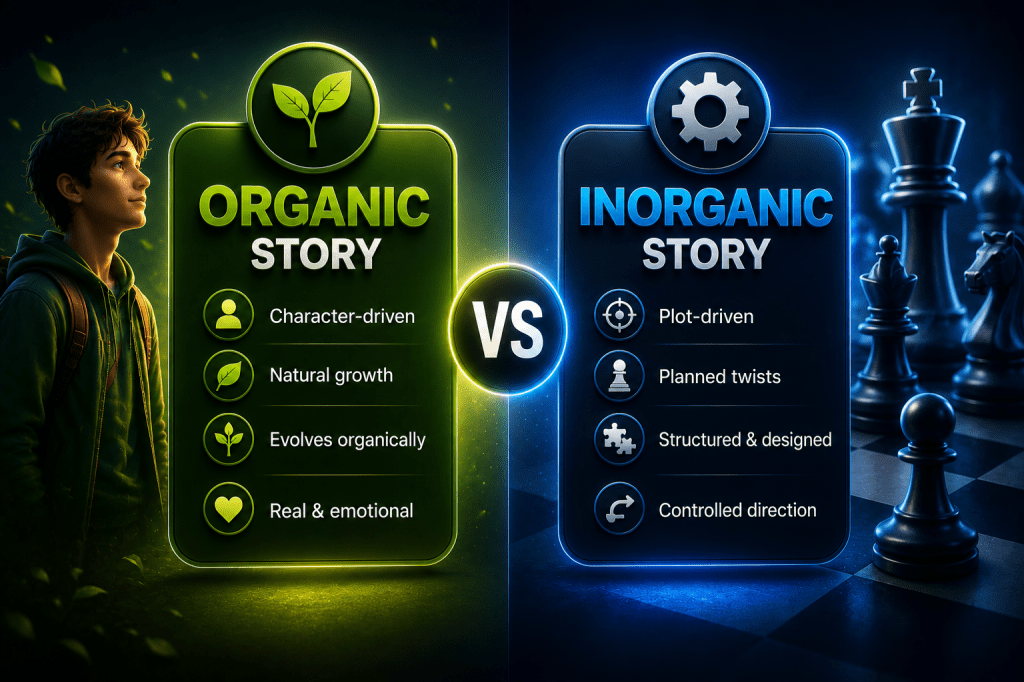
What is Organic Storytelling?
An organic story structure is driven by the characters’ perspectives or actions. Here, the character sketch of each character, including their personality, morals, emotions, backstory, character arc, and every small detail, plays an essential role.
In this storytelling structure, writers never try to add forced events. In fact, here events happen naturally by the character’s decisions and feel like a logical consequence of the choices the character makes.
This storytelling creates believable characters that can naturally drive the plot towards their destiny. Usually, audiences connect more with organic stories because they feel the characters’ struggles and winnings are natural.
An organic story is quietly similar to a domino effect. Do you remember the domino effect? Where every action is the consequence of a previous action. The same happens here in an organic story. All actions or decisions are bound to logical consequences.
The organic story structure always guides you to stay focused on your character for a real and powerful storytelling experience.
Characteristics of Organic Stories
- Characters shape the plot through their choices. No forced events or plot development required.
- Find more credible characters and character transformation. Here, each emotion evolves naturally.
- Dialogue sounds more authentic and matches each character’s personality.
- Every action has a believable consequence. This creates a chain of logical events to make the story meaningful.
- When characters behave consistently, readers find the story more believable. This authenticity makes the fictional world real.
Steps to Develop an Organic Story Structure
- Give enough time to build your characters. They should have clear goals, fears, flaws, values, and wounds. The better you understand your characters, the more naturally they will react to situations.
- Characters should have a clear reason behind their actions. Strong motivations make decisions believable.
- Don’t try to add multiple plots. Forced dramatic situations can spoil the narrative. Let conflicts arise from characters’ goals, misunderstandings, or circumstances.
- Ensure every action for your characters leads to meaningful consequences that can write future events. This chain of cause and effect creates a logical progression and makes the story well-connected.
- Must add each character’s transformation. A good character sketch and arc can improve the pace of a story. Characters should grow from experiences and failures throughout the story.
What is an Inorganic Story?
An inorganic story structure is driven by a plot. In which every element, such as characters, conflicts, setup, dialogue, scenes or more, is intentionally controlled by the plot to achieve a specific narrative.
Here, writers strategically design the narrative to deliver suspense, twists, or a unique fictional world. Each event is smartly placed at a particular time and revealed strategically. Usually, this kind of narrative overpowers the characters. Characters just play a role to ensure the story reaches its final destination. The real hero becomes the plot.
In this structure, every event shows necessity. This increases the credibility. In fact, many bestselling thrillers, mysteries, fantasy novels, and films rely on carefully written plots.
It takes more time and effort, but once writers learn to execute it, this storytelling structure creates an impactful, suspenseful and engaging experience for the audience.
Characteristics of Inorganic Stories
- The story is primarily driven by the plot rather than characters. Every event is carefully planned to move the narrative toward a specific climax.
- Major techniques, like misdirection, breadcrumbing, and show, don’t tell, are used strategically to create a shocking but believable story.
- The use of symbols, settings, metaphors, and objects is huge here.
- The narrative moves quickly, giving less time to think. Every action, scene or symbol is designed to maintain momentum.
- Writers carefully control each piece of information. These stories usually feature more extraordinary worlds, technologies and settings. These elements add curiosity in the audience.
Steps to Develop an Inorganic Story Structure
- Begin with the central concept. Create a unique premise and build the entire story around that.
- Outline the key events before drafting. Do much brainstorming to develop plots. Include the inciting incident, turning points, and climax and tightly structure them.
- Strategically place events to create suspense. Reveal clues, backstory, and secrets gradually. You can use flash cards. Also, techniques like misdirection can help here.
- Each major event should make the protagonist’s situation more difficult. Increasing risks and challenges keep readers invested.
- Always keep in mind that every scene, conflict, and character decision should support the story’s central theme.
Linear vs Non-Linear Storytelling. A Complete Guide for Writers.

What is a Linear Story Structure?
A linear story structure is a storytelling method in which events unfold in chronological order. The story simply begins with the introduction of the characters and setting. Then progresses through central conflict. Then the climax comes, and finally, resolution. The audience experiences the story the same way the characters do. It is simple and one of the oldest and most used narratives.
Linear storytelling does not feature major flashbacks or time jumps. In this storytelling, each event naturally leads to the next. The audience prefers these kinds of stories because they are clear and easy to understand.
Most beginner writers prefer linear storytelling. This method is effective for genres such as romance, adventure, family drama, and children’s fiction. Once writers learn to execute linear storytelling, they can create an engaging, emotionally satisfying experience for their audience.
Characteristics of Linear Storytelling.
- Events happen in the exact order they occur, with no heavy flashbacks. This straight timeline helps readers easily understand the story.
- Each scene builds logically upon the previous one. Changes naturally through time or location. The audience can enjoy it even while multitasking.
- Characters evolve consistently through a sequence of challenges.
- Has predictable narrative flow. The story follows a familiar beginning, middle, and end.
- Shows strong emotional momentum. The audience experiences events alongside characters; builds a strong emotional attachment.
Steps to Develop a Linear Story Structure.
- Begin by introducing the protagonist and the story’s world. Establish the tone and normal life before introducing central conflict.
- Introduce the character’s want and primary obstacle/antagonist that disrupts the protagonist’s ordinary life. This conflict should change the story’s direction and force the character to take meaningful actions. Make your hero the architect of his own misery.
- As the story progresses, increase the challenges that test the hero’s abilities. Keep everything linear. Avoid flashbacks.
- Build emotional engagement throughout the narrative. Bring the story to its highest point of tension. The climax should show whether the character succeeds or fails.
- After the climax, show how the main conflict is resolved and the characters have transformed through the narrative.
What is a Non-Linear Story Structure?
A non-linear structure is a storytelling method in which events unfold out of chronological order. Its events include flashbacks, parallel timelines, multiple perspectives, reverse chronology or more. In this structure, every event or detail is strategically placed by writers to create mystery or deeper emotional impact. Techniques such as misdirection, breadcrumbing, or foreshadowing are commonly used here.
This storytelling method is widely used in psychological thrillers, crime mysteries, and experimental cinema. Here, writers get more freedom to show multiple events happening from different perspectives. They have control to reveal events at a particular time.
Mostly experienced writers use this structure. These stories demand highly logical and well-executed events. Once writers learn to use this technique, they can change a simple story into a powerful cinematic experience.
Characteristics of Non-Linear Storytelling.
- The story unfolds multiple timelines. These timelines reveal backstories, flashbacks, and perspectives. And finally connect at a point.
- Information is strategically revealed by writers. They leave cues throughout the narrative. That keep uncovering the story’s hidden truths.
- Flashbacks or backstories connect the audience to past events that explain a character’s motivations, relationships, or conflicts.
- Writers feel more creative freedom. They write the story as they want to show to their audience. They unfold two or more storylines simultaneously, and the audience finds it genuine.
- The audience actively participates here. They know if they miss any event, it might puzzle the whole story.
Steps to Develop a Non-Linear Story Structure.
- Write the complete timeline first. Brainstorm the idea fully. Before rearranging events, write the story in chronological order. Understand the complete sequence. Then start the non-linear method to strategically place clues for later reveal.
- Every event should have a clear purpose. Smartly place the information. And use backstories and flashbacks following the theme or narrative.
- Reveal information over time to connect the audience. Your audience should discover important clues for later revelations.
- Clearly show changes in narrative using dates, locations, character ages, visual cues, or more. Strong transitions help the audience follow the timeline.
- Make the characters’ emotional journeys believable. Every scene should contribute naturally to their growth and overall transformation.
Final Words!
Understanding organic, inorganic, linear and non-linear story structures can transform the way you write novels, screenplays, and audio dramas. The right structure can help you create stronger and more impactful stories that connect your audience from beginning to end.
Try to experiment with these structures. The more you practice, the more naturally you will recognise which structure your story needs.
Now, it is your turn, writers!
Share your thoughts in the comments below.
What type of story structure do you prefer: Organic, Inorganic, Linear, or Non-Linear?
Also, if you found this guide helpful, please share it with your fellow writers. Your share can help more storytellers learn and grow.
And don’t forget to share your valuable feedback. Your every word matters to us and helps us create more valuable content.
Happy Writing!
Simran Thakur
Founder & CEO, AFAWW
Author| Audio story scriptwriter| Screenwriter| Blogger| Poet















Leave a Reply