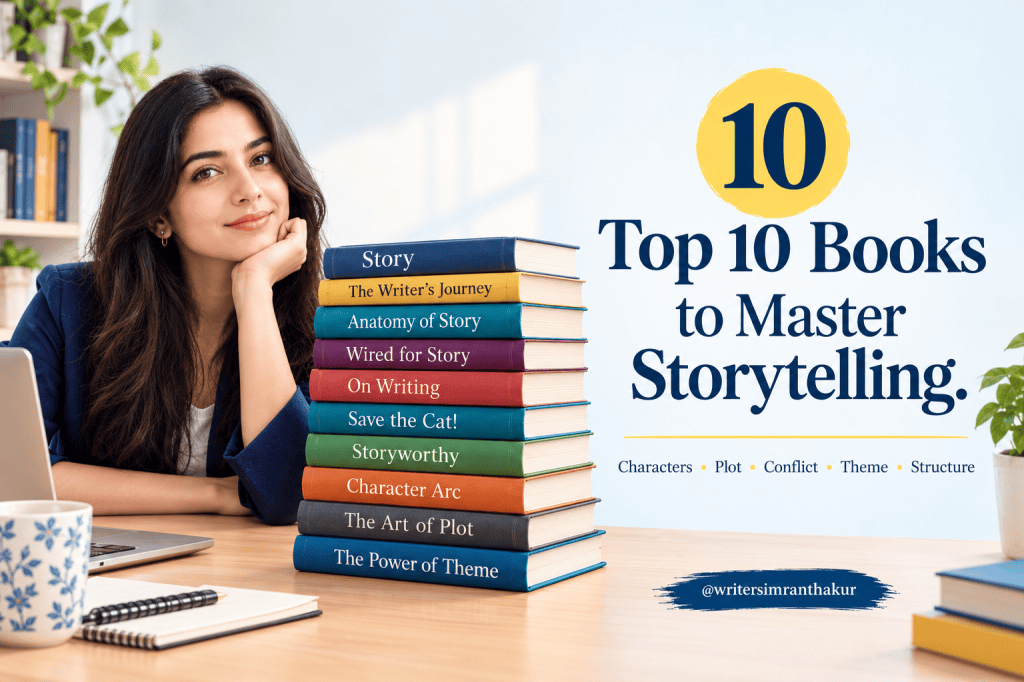
Some storytelling books are like a dedicated mentor. A mentor whose invaluable lessons about writing help us create a magnum opus at every stage. These books hold precious knowledge that guides everyone, whether you are a novice writer or a professional.
As a writer, I know having a good idea is the first victory in the writing process. Still, an idea alone is not enough. A story has many essential elements, such as characters, worlds, plots, structure, scenes, dialogue, emotions, conflicts, writing techniques, psychological factors, industry standards and more. How a writer connects the reader to their story is also part of storytelling.
Now, many questions are running through your mind. Some are about the storytelling process, and some are about the resources that teach storytelling. Don’t worry! I have listed the top 10 storytelling books to answer all your queries.
Whether you are an aspiring author, short-story writer, screenwriter, micro-drama writer, audio-story scriptwriter, or blogger, these books will help you understand profoundly how stories work. They will guide you on how characters create, world-build, plant clues, follow structure, understand psychology, create plots, write scenes and dialogue, and infinite minor details many writers miss today.
In this blog, I’ll share 10 highly regarded storytelling books that help writers learn different aspects of storytelling. Just read the whole blog and find the best option for you and your writing style.
Let’s dive into it.
1. The Anatomy of Story: 22 Steps to Becoming a Master Storyteller.
Buy Here: The Anatomy of Story
“The Anatomy of Story: 22 Steps to Becoming a Master Storyteller” is written by John Truby. This book provides a detailed approach to developing compelling stories. It focuses on premise, character development, plot, moral choices, conflict and story design. It gives numerous examples of feature films that ultimately help writers learn from real examples.
The Anatomy of Story’s first edition was published in 2007/2008. In it, John Truby teaches a 22-step approach to storytelling that acts like an invaluable screenwriting class.
About the Author: John Truby is a renowned story consultant and the founder of Truby Writers Studio. He has worked with major studios including Disney, Sony Pictures, FOX and HBO. His other major book, “The Anatomy of Genres,” explores how different genres use and transform fundamental story principles.
5 Reasons to Read “The Anatomy of Story:”
- The book covers almost every fundamental of storytelling with real examples.
- It includes premise, seven key structure steps, character, moral argument, story world, symbol web, plot, scene construction and dialogue.
- Its 22-step method connects every element so that plot, character and theme work together.
- Writers can use this book to develop an idea into a complete story.
- Truby’s storytelling advice suits multiple formats, including screenplays, novels, and audio stories.
2. Story: Substance, Structure, Style, and the Principles of Screenwriting.
Buy Here: Story
“Story: Substance, Structure, Style, and the Principles of Screenwriting” is written by Robert McKee. It is one of the most widely discussed books on storytelling and screenwriting. In this book, Robert explores story structure, characters, scenes and dramatic progression. He clearly describes how stories are structured and how conflict and characters’ choices move a narrative forward.
This book was originally published in 1997. It expands the conepts Mckee teaches in his storytelling seminars.
About the Author: Robert McKee is an award-winning writer, teacher, and storytelling consultant. He has worked for production companies, and his seminars have attracted writers, producers, and entertainment industry professionals.
His other famous books include “Dialogue: The Art of Verbal Action for Page, Stage, and Screen,” “Character: The Art of Role and Cast Design for Page, Stage and Screen,” and “Storynomics.”
5 Reasons to Read “Story:”
- The book explores story structure, character, scene design, acts, sequences, conflict, antagonism, turning points, climax, dialogue, subtext, and the relationship between structure and character.
- McKee uses real examples from films and classic stories to teach why particular storytelling works.
- This book primarily focuses on screenwriting, but its basic principles are useful for other storytellers.
- Writers should read Story because it encourages them to understand why a story works.
- This book helps writers analyse their own plots, scenes, characters, and dramatic movement of a story.
3. The Writer’s Journey: Mythic Structure for Writers.
Buy Here: The Writer’s Journey
“The Writer’s Journey: Mythic Structure for Writers” is written by Christopher Vogler. This book explores the Hero’s journey and the basic patterns that appear in many stories. Here, Vogler’s teachings on archetypes and transformational journeys help writers to structure compelling narratives.
The Writer’s Journey’s current 25th Anniversary Edition presents a 12-stage approach to story structure and character development.
About the Author: Christopher Vogler is a Hollywood story consultant, screenwriter, author, and educator. He has worked with major studios, including 20th Century Fox, Walt Disney Pictures and Animation, and Paramount Pictures. His work includes Aladdin, The Lion King, and Hercules.
5 Reasons to Read “The Writer’s Journey.”
- The book explores a 12-stage approach. These include the ordinary world, call to adventure, meeting with the mentor, crossing the threshold, tests, allies and enemies, approach, ordeal, reward, the road back, resurrection, and return with the elixir.
- Here, Vogler explains archetypes, such as the hero, mentor, shadow, shapeshifter, and more.
- Writers can easily understand character transformation, story progression, and narrative structure.
- Its teachings suit novelists, screenwriters, and others.
- It is a worthy option for writers who want to understand the Hero’s Journey in its full essence.
4. Wired for Story: The Writer’s Guide to Using Brain Science to Hook Readers from the Very First Sentence.
Buy Here: Wired for Story
“Wired for Story” is written by Lisa Cron. This book explores how readers process stories and why certain elements create curiosity and keep readers engaged. In this book, Cron explains storytelling from readers’ perspective.
Wired for Story was published by Ten Speed Press in 2012. If you want to understand why readers keep turning pages, this book is an excellent addition to your writing library.
About the Author: Lisa Cron is a story coach, speaker and author. She has worked as a literary agent and story consultant with Warner Bros. and the William Morris Agency. Her major books are “Story Genius: How to Use Brain Science to Go Beyond Outlining and Write a Riveting Novel” and “Story or Die: How to Use Brain Science to Engage, Persuade, and Change Minds in Business and in Life.”
5 Reasons to Read “Wired for Story.”
- Wired for Story explores reader curiosity, emotional engagement, the brain science behind the hook, story structure, stakes, tension, and narrative progression.
- Its chapters explain how the brain experiences story and connect it to practical storytelling techniques.
- Here, Lisa briefly explains how to use brain science to hook readers from the first sentence.
- This book helps you understand that compelling storytelling is not simply about beautiful prose or interesting events.
- Cron focuses on the underlying “why” behind what characters do and how that keeps readers invested in discovering what happens next.
5. On Writing: A Memoir of the Craft
Buy Here: On Writing
“On Writing: A Memoir of the Craft” is written by Stephen King. This book combines King’s personal experiences with some practical advice for writing. He shares advice on developing the skills, habits, and discipline needed to write effectively.
On Writing was originally published in 2000. The book has remained a bestseller and is also listed in TIME magazine’s Top 100 Nonfiction Books of All Time.
About the Author: Stephen King is one of the world’s most widely read authors. He has written more than 60 books. His successful titles are “It,” “The Shining, Carrie,” “The Stand,” “Pet Sematary,” “The Dark Tower series,” “11/22/63,” and “Misery.” Many of his works have also been adapted for film and television.
5 Reasons to Read “On Writing.”
- On Writing discusses plot and character development, description, dialogue, revision, writing habits, reading, research, rejection, and the writer’s toolbox.
- King’s approach to writing, revision, and storytelling can strengthen your craft.
- His examples and observations from his own writing career make the lessons practical.
- Writers can learn the importance of reading, writing, revising, and developing practical writing habits.
- For aspiring writers, this book is more valuable for understanding the beginning steps of the writing journey.
6. Save the Cat!: The Last Book on Screenwriting You’ll Ever Need.
Link: Save the Cat!
“Save the Cat!: The Last Book on Screenwriting You’ll Ever Need” is written by Blake Snyder. This book is originally written for screenwriters. It presents a practical approach to story structure through a sequence of story beats. However, many of its concepts can also help novelists and other storytellers understand pacing and narrative structure.
Save the Cat! was first published in 2005. The book became known for its 15-beat story structure. In fact, the book has remained a #1 Amazon title in the Screenwriting category for more than 20 years.
About the Author: Blake Snyder was an American screenwriter, producer, teacher, and lecturer. During his 20-year screenwriting career, he sold numerous scripts, including Blank Check and Nuclear Family. His two major books are “Save the Cat! Goes to the Movies: The Screenwriter’s Guide to Every Story Ever Told” and “Save the Cat! Strikes Back: More Trouble for Screenwriters to Get Into… and Out Of.”
5 Reasons to Read “Save the Cat!”
- The book introduces 15 story beats, from the opening Image to the final Image.
- Introduces 10 story genres and focuses on character transformation, pacing, structure, conflict, and emotional progression.
- Writers can briefly learn about story beats, pacing, turning points, character arcs and audience expectations.
- The famous “Save the Cat!” idea highlights some reason to care about the protagonist.
- For aspiring screenwriters, its beat sheet can be a useful tool for outlining, analysing, and revising a screenplay.
7. Storyworthy: Engage, Teach, Persuade, and Change Your Life Through the Power of Storytelling.
Buy Here: Storyworthy
“Storyworthy: Engage, Teach, Persuade, and Change Your Life Through the Power of Storytelling” is written by Matthew Dicks. This book focuses on personal storytelling. Here, Matthew explains how ordinary experiences can become engaging stories through selection, structure, and emotional meaning.
Storyworthy was published in 2018. In it, Mathews presents storytelling as a learnable skill rather than something reserved for naturally gifted storytellers.
About the Author: Matthew Dicks is a bestselling novelist, teacher, and storytelling coach. His other popular novels are “Memoirs of an Imaginary Friend,” “Something Missing,” “Unexpectedly,” “The Other Mother”, and more. His other nonfiction books include “Someday Is Today” and “Stories Sell.”
5 Reasons to Read “ Storyworthy.”
- The book covers stories in everyday life.
- It talks about meaningful moments, emotional change, story structure, and audience engagement.
- Writers can learn how to find stories in everyday experiences and transform them into memorable narratives.
- It prepares writers to discover storytelling potential in ordinary human experiences.
- Its practical approach can help aspiring writers develop stronger observation skills and turn real experiences into engaging stories.
8. The Science of Storytelling: Why Stories Make Us Human and How to Tell Them Better.
Buy Here: The Science of Storytelling.
“The Science of Storytelling: Why Stories Make Us Human and How to Tell Them Better” is written by Will Storr. This book combines storytelling principles with psychology and neuroscience. Here, Storr explains how characters, conflict, beliefs, and narrative change affect the reader.
The Science of Storytelling was first published in 2019. It answers why certain stories capture our attention and how writers can use an understanding of the human mind to create more compelling narratives. This book became a Sunday Times bestseller.
About the Author: Will Storr is an award-winning British writer, journalist, novelist, and teacher. His journalism has appeared in “The Guardian,” “The Sunday Times,” and “The New York Times.” His other popular books are “The Status Game,” “Selfie: How We Became So Self-Obsessed,” “The Unpersuadables,” “Brainology,” and “A Story Is a Deal.”
5 Reasons to Read “The Science of Storytelling.”
- The book explores character psychology, curiosity, conflict, story worlds, myths and archetypes, plot, endings, and emotional engagement.
- It also includes a practical “Sacred Flaw Approach” for developing characters.
- Here, Storr illustrates his ideas using examples from Harry Potter, Jane Austen, Breaking Bad, Russian novels, Greek drama, and more.
- Writers can learn how human psychology can influence readers’ experience of a story.
- It is particularly valuable for writers who want to understand how and why a story works on the human mind.
9. Bird by Bird: Some Instructions on Writing and Life.
Buy Here: Bird by Bird
“Bird by Bird: Some Instructions on Writing and Life” is written by Anne Lamott. This book acts as a beloved writing classic that combines practical advice with the challenges of being a writer. It addresses perfectionism, self-doubt, character, dialogue, revision, and the process of getting words onto the page.
Bird by Bird was first published in 1994. It is one of the most widely recommended books on writing and has become a New York Times bestseller.
About the Author: Anne Lamott is an American novelist and nonfiction writer. She has written twenty books and seven novels. Her major books are “Travelling Mercies,” “Operating Instructions,” “Help, Thanks, Wow,” “Almost Everything,” “Dusk, Night, Dawn,” and “Small Victories.”
5 Reasons to Read “Bird by Bird.”
- Bird by Bird explores the real process of becoming and continuing to be a writer.
- The book includes practical discussions on getting started, short assignments, character, plot, dialogue, setting, false starts, writer’s block, and more.
- Lamott discusses creative insecurity, perfectionism, procrastination, first drafts, revision, and the emotional challenges writers face.
- The book encourages writers to stop worrying about the entire story at once and instead work “bird by bird,” one manageable piece at a time.
- Its lessons make it especially useful for novelists, bloggers, screenwriters, and beginners who struggle to turn ideas into finished work.
10. Into the Woods: How Stories Work and Why We Tell Them.
Buy Here: Into the Woods.
“Into the Woods: How Stories Work and Why We Tell Them” is written by John Yorke. This book explores narrative structure and the patterns behind successful stories. Here, Yorke examines the relationship between story structure, transformation, and audience expectations.
Into the Woods was first published in 2013. A later edition, Into the Woods: A Five-Act Journey Into Story, was published by Abrams.
About the Author: John Yorke is a British television producer, story consultant, lecturer, and narrative expert. He has served as Head of Channel Four Drama, Controller of BBC Drama Production, and Managing Director of Company Pictures. His production career includes acclaimed dramas such as Life on Mars, Shameless, The Street, and Wolf Hall.
5 Reasons to Read “Into the Woods.”
- The book explores major elements, including three- and five-act structure, inciting incident, scenes, characterisation, exposition, subtext, dialogue, and narrative structure.
- Yorke examines narrative through historical, philosophical, psychological, and structural perspectives.
- Explains how different structural patterns can shape a satisfying narrative. This makes this book valuable for novelists, screenwriters, playwrights, and television writers.
- Yorke particularly explores Shakespearean five-act structure and applies it to films, television, theatre, novels, myths, and fairy tales. Examples include The Godfather, True Detective, Mad Men, and more.
- For writers who want to move beyond basic three-act formulas and develop a deeper understanding of storytelling, this book is an excellent study resource.
Final Words!
Storytelling is a craft developed through reading, writing, observation, experimentation, feedback, and continuous learning. To become a writer, you first start writing. And to learn writing, the right knowledge can help you move forward.
Choose the right storytelling book that matches your current writing goals, study it carefully, and then put those lessons into practice. After all, the best way to learn storytelling is not only to read about stories, but to start writing your own.
Now, it is your turn, writers!
I’d love to hear from you all!
Share your experience in the comments!
Which storytelling book is your personal favourite? Tell us which storytelling element it helped you improve the most.
Also, if you found this blog helpful, please share this blog with your writer friends and community who would love to discover their next great storytelling book!
And don’t forget to share your valuable feedback. Your every word matters to us and helps build a better writing community.
Simran Thakur
Founder & CEO, AFAWW
Author| Audio story scriptwriter| Screenwriter| Blogger| Poet













Leave a comment