
How surprising it is that sometimes a novel fails to find a place in our hearts, while a short story connects with us more emotionally. A few words about a single feeling, incident, character or situation leave us speechless. The magic of short stories is that words are fewer but more meaningful, with strong emotions and engagement.
I have found that writing a short story or a film is one of the hardest things in writing. Here, you have limited characters, words, locations, scenes, and time. Still, authors articulate the story beautifully so that their audience never feels they are missing emotions or a worthy story.
Like novels or other storytelling formats, a short story also follows a brief process. It also demands perfectly written character sketches, a central idea, a theme, plot, settings, the three-act structure, rewriting and editing.
Today, I’ll discuss everything about the short story. I’ll cover what a short story is, how it is different from novels, and a step-by-step guide to writing an engaging short story.
Let’s dive into it.
What Is a Short Story?
A short story is a work of fiction that completes a story within a limited number of words. It has a limited number of characters, locations, scenes, and plot points. It usually revolves around one central idea.
The purpose of a short story is to create a meaningful narrative for the reader within a short time. It strongly follows the economy of words.
A short story follows a three-act structure, which means a proper beginning, middle and end. Here, each element is presented concisely, leaving no room for unnecessary information or elements. It can belong to any genre, such as romance, mystery, thriller, horror, fantasy, comedy, and drama. It can be of any theme. Whatever genre, theme, or idea you choose, it should be clearly shown so that it either surprises the audience or serves as a lesson for them in the end.
It is one of the best ways to teach about storytelling structure, pacing, character development, and concise writing. Most authors start their writing journey by writing a short story.
Note: The ideal word count of a short story is not universal. It can vary depending on publishers. It can start from 500 words and go up to 7000 or sometimes more. So read the instructions carefully before submitting the short story.
What Makes a Short Story Different from a Novel?
A short story and a novel both follow the fundamental elements of storytelling, but they differ in many ways.
- A short story is shorter than a novel. It ranges from 500 to several thousand words.
- Focuses on limited characters, locations, words and complexity.
- Revolves around one central idea, conflict or situation.
- Shows calculated character transformation.
- Takes a few hours or a day to prepare/write.
- Moves faster because it avoids unnecessary conversations, descriptions and scenes.
- Limits or omits subplots.
- Aims to provide one powerful emotional experience or life-changing incident that leaves a lasting impression.
A Step-by-Step Guide to Writing an Engaging Short Story.
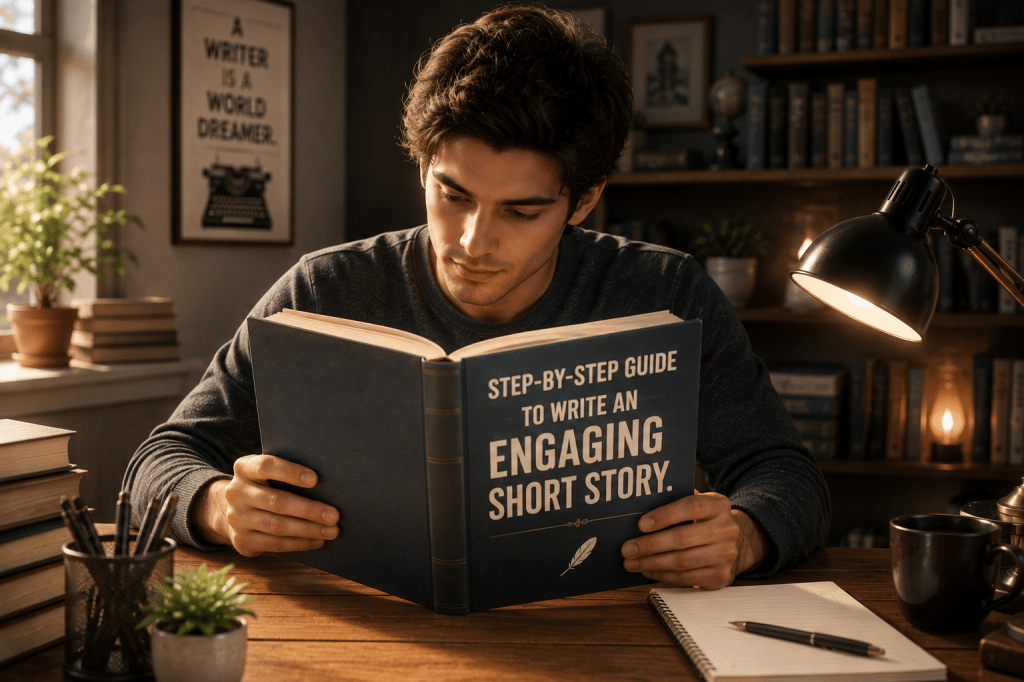
A short story demands precision. Due to limited space, every character, scene, line of dialogue, and description should serve a meaningful purpose.
Let’s understand the whole writing process for an engaging short story.
Step 1: Start With a Strong Story Idea
An idea is the foundation of every story. Give yourself enough time to explore a worthy idea on which your whole narrative will depend. I know no idea is perfect; writers make them perfect with brainstorming, research and writing knowledge. But try to find an idea your audience can relate to.
There are so many ways to find an idea. It can come from your own experience. Your internal struggles/feelings/psychological experiences actually hide plenty of ideas to write good and attractive short stories.
Writers can also get their ideas from outer observations. An article, news, incident, anything can be a reason for a short story. Try to prepare a good premise for your story. It will clear the entire path and provide a natural flow to a story.
Step 2: Set a Clear Theme and Genre.
Be clear about what your short story is, what message it wants to convey and to whom. Every genre has its audience. Some people like thrillers, some prefer romance, some love dramas and more. You should be clear about your theme and genre. Because it ultimately serves a message to a specific audience.
Note: You can refer to the blog “The Difference Between Theme and Genre” to learn these storytelling elements.
Step 3: Choose Characters Carefully with Proper Character Arcs.
Due to a limited word count, everything should be precise and calculated in a short story. More characters mean more descriptions, actions, dialogue, and settings. It will ultimately mess up the entire short story.
Try to avoid unwanted characters. Be specific. Choose the characters that serve the story. A strong protagonist with a clear want, conflict, and obstacle/antagonist works better than multiple characters with no goal.
Try to limit characters to 2-3. The reason is that there is no time to reveal the long backstory or the brief status quo. Limiting your characters will help you develop a strong and impactful narrative in a short time. And keep it in mind. Be clear about each character’s desire, their challenges and transformation. The aim is to create characters that best serve the story.
Step 4: Focus on One Central Conflict.
Build your story around one major conflict. A focused conflict keeps the narrative clear, engaging, and emotionally powerful. Your reader will only connect more emotionally and psychologically when they have a clear reason to read your story. Try to introduce your conflict as soon as possible.
Your conflict can be of any type. It can be internal, where a character struggles with their own fear, guilt or desire. It can be external, when a character struggles against another person, society, nature or circumstances.
Choose one strong conflict rather than many small conflicts. It will help you get to the core of the story throughout the journey.
Step 5: Write an Opening That Hooks the Reader
You are writing a short story; it is a clear signal that your hook should be introduced from the first sentence. If you lack engagement, your reader can easily skip the story.
Writers can choose an action, a dialogue, a description, a situation or an emotional moment to create that hook. It depends on what genre you have chosen and your writing style.
Introducing the hook at the beginning doesn’t mean you get freedom to show leniency in the rest of the narrative. Keep the tension and stakes high constantly to engage the reader till the end.
You can add unpredictability, suspense, unanswered questions, obstacles, and strategically place clues/breadcrumbing to hook your audience throughout the narrative.
Step 6. Build Your Short Story Structure: Three-Act Structure
The Three-act structure works for all storytelling formats. It is the simplest and most useful technique in writing. It has a proper beginning, middle and end. The beginning introduces the character. Establishes the situation. Presents the inciting incident and makes the protagonist the architect of his own misery.
The middle introduces the complications. Rises tensions. Here, characters are forced to make challenging decisions. The character faces problems, finds solutions, and covers a journey of change.
The end is the climax of the story. It clarifies the consequences of every action, decision or development. It reveals whether the world or the protagonist changes. Shows the complete transformation.
Following this structure, writers can strengthen their storytelling foundation.
Step 7: Keep the Setting Relevant
Setting/location/worldbuidling is also plays an essential role in a story. It directly influences the character behaviour, values, beliefs, background, and more.
A short story can be developed in a single location. It depends on the writer’s creativity to use the limited locations appropriately. A setting can include the state’s culture, transportation, economy, atmosphere, and more.
Always remember that adding too many locations can never make your narrative better. In fact, in short stories, it will complicate the situation.
I suggest using 2-3 locations. It helps you understand your specific settings and use them more effectively. It also helps smooth the flow without unnecessary shifts. Use prominent locations that help convey more in fewer words.
Step 8: Create Purposeful Scenes and Plots with Short Descriptions.
Every scene in a short story should be meaningful, and what makes them meaningful is description. Your words are your power. Keep the narrative tight. Use small sentences and specific words to describe the situation/action. Lengthy sentences not only increase the length but can also lose the pace of the narrative.
Your every word/sentence should move the story forward. It consistently reveals clues, increases tension, develops characters, or raises the stakes. Use economy of words while writing.
Use dialogue only when needed. If something is clear in description, don’t waste words by explaining it in dialogue. Save yourself from writing lengthy dialogue or monologue. Use emotions, actions, and subtext to explain the situation. Balancing all together will make a scene worthy.
Also try to avoid complex subplots. It can create an unnecessary maze for the audience. Keep the narrative focused on the main storyline and its emotional purpose.
Step 9: Develop a Strong Ending
The ending is the space where every reader wants to discover something new and surprising. They want to end the story with a clear message. A lasting impression that always lives with them. This expectation forces the writers to create a thought-provoking moment for the end. A moment that should be strong emotionally, practically, and morally.
An ending can be of different types, such as surprising, emotional, twisted, open, and bittersweet. Whatever you choose for your story, it should feel natural, logical and emotionally satisfying. It is not something that suddenly comes. Your whole narrative works to end on this result. Keep it strong and impactful.
Step 10: Revise and Edit Your Short Story
Rewriting is the real writing. Don’t be afraid to remove unnecessary elements from your story. This step makes your story clearer. In writing, this technique is called “kill your darlings.”
Using “Kill your darlings,” writers remove every scene, dialogue, description, action, and character that does not serve the story.
Every author follows this ruthless editing because they know this step ultimately helps their story be better structured and more readable.
As a writer, I also love every idea, word or character I write, but that doesn’t mean they are all meaningful for my current story. They can be placed in different places in different stories, but for a particular story, we only move ahead with those who serve best.
Don’t think twice before rewriting or removing something. It is the most essential step in the writing journey. Make it your habit.
Final Words!
Now, you have learned many facts about short stories. Keep this learning with you and try to apply it in your short story.
A writer is not someone who only thinks. A writer is the creator of believable fictional worlds. They turn imagination into reality. Writes impactful words. Beautiful stories that convey beautiful messages.
Don’t stop at just learning; become an action-taker. Give enough time to explore, learn, observe and write. Create your next worthy short story that deserves to be read.
Now, it is your turn, writers/authors!
I want to hear about your writing journey.
Share your experience in the comments below.
Tell me, have you ever written a short story? What inspired you to begin writing? Which step do you find the most challenging?
Your experience can inspire another writer who is struggling with the same challenge.
Also, if you found this guide helpful, share it with your writer friends and aspiring authors who want to learn the art of storytelling.
Don’t forget to share your valuable feedback. Your every word matters to us and helps us create a better writing community.
Explore More Writing Resources
If you enjoyed this guide, you can also explore my other blogs on audio stories, novels, short films, and microdramas, and practical writing workbooks.
Simran Thakur
Founder & CEO, AFAWW
Author| Audio story scriptwriter| Screenwriter| Blogger| Poet













Leave a Reply