Are you an Indian short story writer? Struggling to find a publisher for your short story collection?
If yes. Don’t worry.
You are in the right place.
Finding the right publisher for your words is challenging. Especially when submission guidelines, genres, and manuscript requirements all vary.
That is why I’m here to solve all your problems.
In this blog, I’ll share the Top 10 Indian Publishers to Submit Your Short Story Collection in 2026. I’ll cover everything you need to know before selecting any publisher- their guidelines, preferred genres, requirements, payment models and benefits.
Whether you are a debut author or an experienced one, this blog will surely help you choose the best publisher for you.
So don’t wait; let’s dive into it.
1. Penguin Random House India
Link: Penguin Random House India

Penguin Random House India is one of the most credible publishing options for Indian writers, but it is highly competitive/selective. If you are an experienced author or have strong, compelling short stories, then this platform is worth approaching.
Penguin Random House India publishes literary or commercial fiction and actively looks for fresh voices. It does not publish every type of short story. It generally targets an adult audience, but that does not mean it will easily accept an adult short story collection.
It demands strong, unique, real, and clear storytelling. That can hook readers. So writers should focus on impactful storytelling. I have some advice. First, complete the manuscript, then polish it, then submit it.
Note: However, its Ebury/Vintage division currently accepts unsolicited fiction manuscripts across genres. Fiction writers can submit the complete manuscript along with a detailed proposal.
Submission requirements:
- Prepare a detailed proposal containing a synopsis.
- Short author biography.
- Three Sample chapters.
Once the proposal is accepted, the platform requires the complete manuscript.
The evaluation process can take at least six months, and PRH India states that if you hear nothing within six months, it is not pursuing the submission.
Monetisation:
- Penguin Random House India follows a traditional publishing route. It offers a publishing contract with financial terms such as advances, royalties and rights.
Writers should evaluate the contract carefully.
Benefits:
- It is India’s leading publishing network and offers brand credibility, publishing and distribution infrastructure.
- Professional editorial teams help refine manuscripts.
- Their books gain space in bookstores, online retailers, libraries, and among readers across India.
- Published titles can reach readers through major online bookselling platforms.
- As part of a global publishing group, selected Indian authors gain opportunities for international readership and recognition.
2. Rupa Publications
Link: Rupa Publications – The House of Bestsellers Books in India
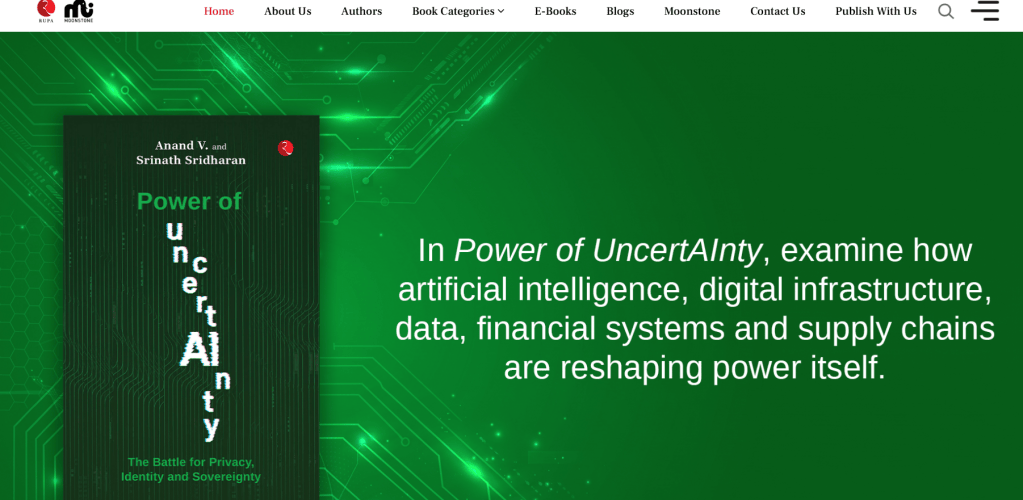
Rupa Publications is a worthy platform for writers with short-story collections. Its submission guidelines specifically mention short-story collections and ask authors to submit three sample stories. Its dedicated Short Story category indicates a strong interest in short-form storytelling.
Rupa accepts fiction and non-fiction in English. Even the famous author Ruskin Bond has published their anthologies with Rupa Publications. This platform accepts stories in multiple genres, including romance, literature, suspense, thriller, classics and children’s books.
Submission requirement:
- Rupa Publications accepts manuscripts in English.
- Firstly, it requires a detailed synopsis with three sample chapters.
- Responses take at least three months.
Note: If the proposal suits the editorial team, they request the complete manuscript before a final decision.
Monetisation:
- Rupa follows a traditional publishing model. If the manuscript is accepted, the platform shares royalty, advance arrangements and more through the contract.
Benefits:
- Rupa has decades of experience publishing Indian and international authors.
- Manuscripts undergo editorial evaluation to ensure selected books will receive professional assessment, editing, proofreading and publishing support.
- Their books reach readers through bookstores, online platforms and distribution channels globally.
- Publishes novels, short stories, children’s fiction, literature and other forms of storytelling.
- Writers can approach Rupa directly without requiring a literary agent.
3. National Book Trust (NBT)
Link: Welcome to National Book Trust India
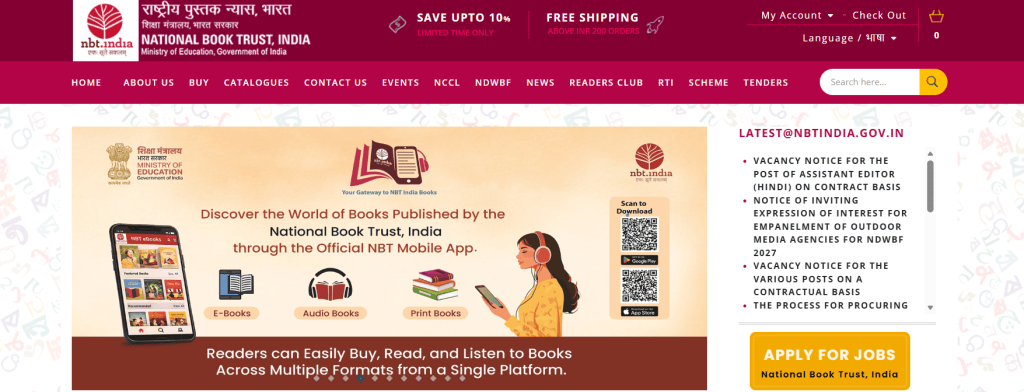
The National Book Trust is a highly credible option for writers interested in regional languages. It is a government-established organisation that works autonomously. This publisher is not a commercial publisher and focuses on contemporary fiction and short-story collections. It primarily focuses on culturally relevant literature. It selects relevant stories and essays for commissioned anthologies.
The National Book Trust mentions that it accepts eligible stories, but acceptance is selective. Its genres include Indian literature, Children’s literature, history, environment, science, biographies, and social and cultural topics.
Submission Requirement:
- Writers should submit a brief synopsis of the collection with five sample stories.
- A cover letter that clearly mentions the relevant publishing series.
- Manuscripts should be properly typed, double-spaced and paginated.
Note: NBT does not allow simultaneous submissions, so writers should not send the same proposal to another publisher while NBT is considering it. Also, Manuscript submissions receive priority when sent during 1–30 April, 1–30 September or 1–31 December.
Monetisation:
- NBT follows a formal traditional publishing model. Once a manuscript is accepted, their team shares an agreement with the author with detailed terms and conditions and royalties.
- NBT also publishes ebooks and translations. Writers get huge opportunities for wider distribution.
Benefits:
- Established by the Government of India to promote books, reading habits and literature across diverse Indian communities.
- Publishes books in multiple languages to support every regional language of India.
- Its long history gives it considerable credibility. NBT actively contributes to India’s reading and literary culture.
- Its publications reach readers through distribution networks, bookshops, exhibitions and various literary events across different parts of India.
- Selected works can reach wider audiences through translation. Authors can display their books at fairs, seminars and literary activities.
4. Setu Prakashan
Link: Setu Prakashan Samuh – Buy Best Books of Hindi Sahitya – Hindi Novels
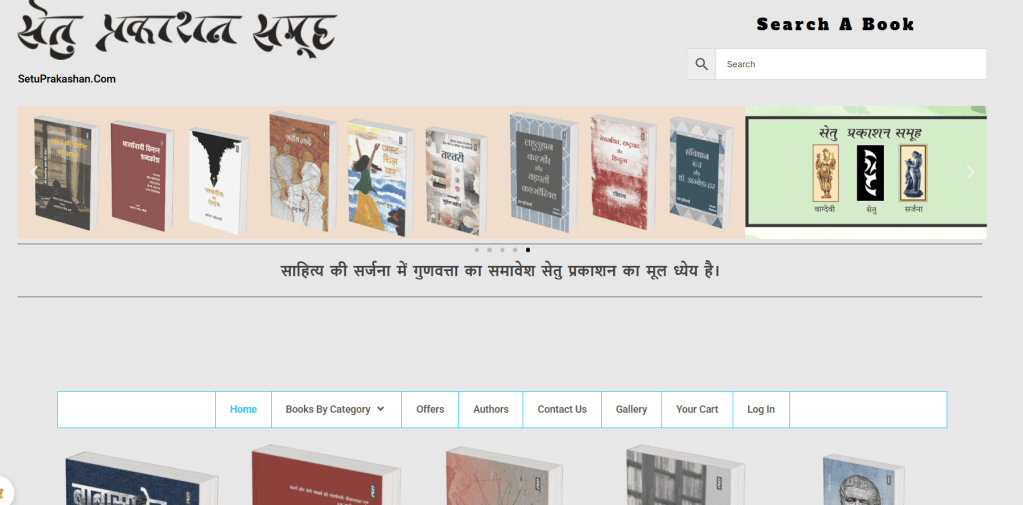
Setu Prakashan is one of the most relevant Indian publishers for short-story publishing. Its official submission policy transparently mentions short-story collections. Its catalogue already includes numerous story collections and Hindi literary writers.
Setu Prakashan accepts Hindi manuscripts across genres. Its catalogue clearly shows a strong literary presence in the publishing market. It includes novels, plays, biographies, philosophy, history, and culture-relevant books. The list shows that literary, socially and culturally rooted books can be suitable genres.
Writers with strong writing skills and credibility must share their scripts with Setu Prakashan.
Submission guidelines:
- Authors need to submit a detailed synopsis and three sample stories by email or hard copy.
- The manuscript should include the writer’s full name and complete contact details.
- Save a copy because submitted material is not returned.
- Writers can expect a response in 10–12 weeks.
Note: If the editorial team finds the manuscript interesting, it will request the complete manuscript before final publishing.
Monetisation:
- Setu follows a traditional publishing model.
- If a manuscript is accepted, it shares its commercial terms and a publishing contract with authors.
Benefits:
- Setu Prakashan primarily promotes and accepts Hindi literature and short-story collections.
- Writers can submit their manuscripts directly to Setu without a literary agent.
- Setu welcomes emerging writers alongside established authors within contemporary Hindi literature.
- Its wide catalogue includes fiction, short stories, history, poetry, social and cultural works and more.
- Selected manuscripts are professionally published as physical books, online channels and bookstores.
5. Speaking Tiger Books
Link: Speaking Tiger Books – Many Voices. Free Voices
Speaking Tiger is a very strong option for short-story writers. In fact, its catalogue has a dedicated Short Stories category with many titles. It is a great option for literary, contemporary and culturally distinctive stories.
Speaking Tiger accepts both fiction and non-fiction manuscripts in English. Its catalogue covers genres such as literary fiction, romance, thriller, suspense, mystery, crime, novels and more. Its short fiction also shows a strong interest in topics like society, history, culture and human relationships.
Submission guidelines:
- Writers should submit a query letter.
- Add a brief synopsis and three sample chapters/stories.
- Use a Word document in Manuscript format with double spacing.
- The author’s details must be included.
Note: Writers should allow 8–10 weeks to evaluate an initial submission. A request for the full manuscript does not guarantee publication.
Monetisation:
- Speaking Tiger is a traditional publisher.
- If a manuscript is accepted, it shares its commercial terms and a publishing contract with authors.
Writers should carefully read royalty percentages and rights before signing the agreement/contract.
Benefits:
- Allows writers to submit manuscripts directly without requiring a literary agent.
- Has already developed a recognised position within India’s independent publishing market.
- Selected manuscripts are professionally produced as physical books and reach readers through online stores, bookstores and other channels.
- Has a wide catalogue that opens the door for diverse genres.
- Speaking Tiger maintains a dedicated short-story category, releases anthologies and translated literature. Readers can purchase books directly through its website.
6. Book Saga Publications
Link: https://booksagapublications.com/
Book Saga Publications is also a strong option for writers looking to publish short-story collections. Its submission guidelines clearly mention short stories as an eligible format. That enhances its relevance for writers.
Book Saga Publications accepts both finished and unfinished manuscripts. It also accepts anthologies, series and trilogies. It accepts multiple genres with engaging and strong storytelling.
Submission Guidelines:
- A short-story collection must contain at least four short stories.
- Each story should be at least 2,000 words.
- Writers should submit a detailed summary.
- Writers can send all documents by email or to Saga’s manuscript-submission address.
- The publisher also considers unfinished manuscripts, so writers do not need to have a complete manuscript.
Monetisation:
- Saga follows a traditional publishing model.
Writers should assess the publishing agreement for royalties, advance, rights, print/ebook formats and distribution before signing.
Benefits:
- Saga clearly accepts short-story collections, making space for short-story writers.
- The publisher also considers edited works and unfinished manuscripts.
- Writers can approach Saga directly with their manuscripts.
- It publishes different forms of literary works and provides opportunities across various storytelling formats and categories.
- Welcomes emerging writers seeking traditional publication for short-story collections.
7. Zubaan Books
Link: Home – Zubaan
Zubaan Books is one of the strongest publishers that accepts literary short fiction in India. It is beneficial for writers whose collections focus on topics such as women’s experience, gender, regional cultures, social issues and more. Northeastern Indian writing is also very popular in Zubaan publications. It describes its fiction list as a mix of short stories and novels.
Zubaan Books is highly recommendable for both established authors and new voices. They are not afraid to try something new and fresh.
Submission Guidelines:
- The initial submission requires a cover letter, synopsis and a maximum of three sample chapter/stories.
- Author’s bio.
- Zubaan asks writers to submit Word or PDF files.
- If the editorial team is interested, it will request the complete manuscript.
Note: Writers normally receive a response within 8–12 weeks if the manuscript is being considered.
Monetisation:
- Zubaan primarily follow traditional publishing.
Writers should examine the publishing contract for royalties, rights, formats and other commercial terms.
Benefits:
- Zubaan is an independent publishing house known for promoting feminist perspectives.
- It actively publishes short-story collections, making it a good choice for specific writers.
- The publisher works with both emerging and established authors.
- Selected manuscripts are published in physical and e-book formats. Reaches readers through established Indian and international distribution networks.
- Authors benefit from professional editorial, design, production and publishing processes.
8. Magic Mongrel Publishers
Link: Home – Magic Mongrel Publishers
Magic Mongrel Publishers is one of the worthiest options for short-story collections. Its website clearly mentions that it specialises in novels and short stories, but it is more relevant for collections.
It is an independent publisher that focuses on unique and new voices. It accepts submissions in English only. Also accepts poetry, non-fiction, plays, and more.
Magic Mongrel does not restrict itself to one genre, but it demands highly professional, clear and innovative storytelling. It distributes its books through its own store and in paperback/Kindle formats.
Submission Guidelines:
- The manuscript should be proofread and complete.
- Writers should format the manuscript in Times New Roman, 12-point font with 1.5-line spacing.
- The first page should contain the title, author name, month/year and contact details.
- The query letter should mention the word count, genre, target audience and why the manuscript is a good fit.
- Writers must also attach a one-page synopsis and three sample chapters/stories.
Monetisation:
- Magic Mongrel Publishers follows a traditional publishing model.
Note: Its public submission guidelines do not specify a standard royalty percentage, so authors should examine the contract carefully.
Benefits:
- Magic Mongrel accepts manuscripts directly without a literary agent.
- Accepts completed short-story collections and offers a focused publishing environment.
- Welcomes innovative, experimental and unique storytelling.
- Selected works are published in both e-book and paperback format.
- Readers can purchase Magic Mongrel books directly through its website.
9. Write India Publishers
Link: Write India – India’s Favourite Traditional Publishing House
Write India Publishers is another strong option for short-story writers. Its official submission guidelines mention short-story collections and anthologies. It mentions short-story collections as a recognised format. That makes it a worthy platform for writers’ collections. It publishes books in English, Hindi and Gujarati.
Write India Publishers has a huge list of preferred genres. These include Indian literature, thriller, science fiction, romance and feel-good stories.
Submission guidelines:
- Writers submit a 1,000–1,500-word synopsis.
- Add 4–5 sample short stories.
- A third-person author bio under 400 words with a photograph, and the manuscript’s total word count.
- Submissions in DOC or PDF format.
- Authors may send a reminder if they get no response in three months.
Monetisation:
- Write India describes its model as traditional publishing.
- Royalty, number of copies and distribution arrangements are discussed only after final acceptance.
Note: Writers should read the contract carefully.
Benefits:
- The publisher provides editorial assistance to improve clarity and professional quality.
- Assists ISBN, copyright and distribution support.
- Selected manuscripts can be published in both print and digital formats.
- Authors receive marketing, promotional support and book-launch activities.
- The publisher supports author branding alongside book promotion to build author visibility.
10. Rajmangal Publishers
Link: Hindi Book Publishers in India | Rajmangal Publishers | Book Publishing House
Rajmangal Publishers is especially relevant for Hindi and Indian-language short-story writers. It also accepts English submissions. Its official submission page lists short stories, fiction and novels. The catalogue contains published Hindi short-story collections.
Rajmangal Publishers has a broad range of genres. Its catalogue mentions literary fiction, romance, mystery, fantasy, thriller, crime, science fiction, suspense, classic literature and more.
Submission Guidelines:
- Writers send their manuscript by email.
- Manuscripts should be in a Word or PDF attachment.
Note: It does not specify a minimum number of stories, so writers should prepare a complete proposal before submitting.
Monetisation:
- Rajmangal is a traditional publishing house.
- Once the manuscript is accepted, it will send an agreement containing all information regarding royalties, rights, and more.
Authors should discuss royalties, print copies, rights, ebook income and distribution terms before signing a publishing agreement.
Benefits:
- It has a strong Hindi publishing identity. That can become a trustworthy space for regional writers.
- Accepts short stories and collections. That makes it a relevant option for short-fiction writers.
- Selected books will be published in paperback, hardcover, and e-book formats.
- The publisher provides distribution across India.
- Its translation capabilities support the adaptations.
Final Words!
That time has gone when your words stayed in a notebook or Word file and remained unpublished for years. Today, you have plenty of options. The only thing is to take a step ahead.
You know your strength. You know your writing style. You know which format is best for you.
Don’t be afraid or stop writing by assuming your words will remain unpublished. Indeed, today, there is no shortage of publishers for any writing style.
Just focus on your words, skills and knowledge. Your words deserve a physical presence in this world, and you are capable enough of giving them that presence.
Now, it is your turn, Author!
I’d love to hear your experience.
Tell me in the comments,
- Which publisher would you choose for your short-story collection?
- Any publisher you recommend to your writer friends?
Share your stories below.
Also, if you found this guide helpful, please share it with fellow writers who are looking for short-story publishing opportunities.
And don’t forget to share your feedback. Your every word matters to us and helps us create better content for the writing community.
Bonus!
Here are some blogs that will surely help you elevate your writing journey in the short-story world.
Must-read!
1. How to Write an Engaging Short Story.
2. Top 10 Global Digital Platforms to Publish and Earn Money from Short Stories
3. Top 10 Indian Digital Platforms to Publish and Earn Money from Short Stories.
Simran Thakur
Founder & CEO, AFAWW
Author| Audio story scriptwriter| Screenwriter| Blogger| Poet















Leave a comment