How can you ignore the artificial intelligence in every minute-changing era? This is an undeniable fact: AI is changing the world. Its wings have reached in every professional field. If you ignore its presence, power, and creativity, you are ignoring a massive technology that can enhance your creativity.
I know many writers are afraid of using AI tools. They thought Artificial intelligence would replace their words, creativity, and need, but is it a complete fact?
The truth is, for now, AI can’t replace human writers because humans have mental and emotional intelligence. AI struggles with long-term storytelling, which can only be impactfully managed by the human brain. Our feelings and logical reasoning encourage us to write credible stories that connect with the audience.
It doesn’t mean AI is worthless. No! Absolutely not! But! Rather than making AI your competitor, you can make it a best collaborator.
Today, many authors, screenwriters, and storytellers are using AI tools to enhance their creativity. But the question arises, “Which AI help humans tell better stories without taking over the creative process?”
The answer is Google’s Fabula AI. It is an experimental AI storytelling tool developed by Google Research and Google DeepMind. Google’s Fabula is especially designed for screenwriters and storytellers. It keeps the voice of a human writer in control while helping organise story structures, plots, scenes, narrative, and creative roadblocks. Google’s Fabula AI can become an evolution in the screenwriting software industry.
If you are curious to know more about Google’s Fabula AI. This blog is for you. In this blog, I’ll explore everything currently known about Google DeepMind’s Fabula AI. This is the time to upgrade yourself with trending AI, my writer friend.
Let’s dive into it.
What is Google DeepMind’s Fabula AI?
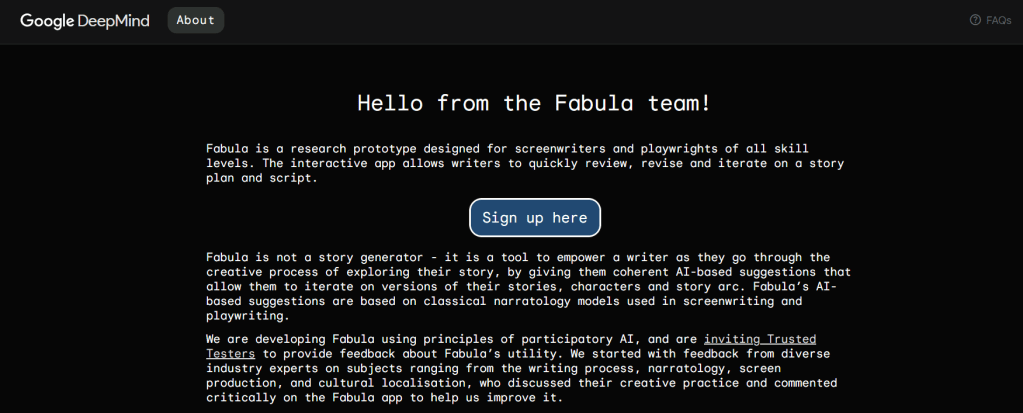
Google DeepMind’s Fabula AI is an experimental AI-powered storytelling tool developed by Google Research and Google DeepMind. It is especially designed for professional writers to assist them in long-form narratives. You can include screenwriters and storytellers in this category.
Fabula AI uses Google’s Gemini family of language models to understand story structures. Using that, it provides suggestions throughout the writing process.
One of its defining features is a hierarchical story-planning system. It organises narratives into multiple levels, such as the overall story, character arcs, world, acts, scenes, actions and beats, which makes it easier for writers to maintain consistency across long scripts.
During the development of Fabula AI, Google worked with 42 professional screenwriters and playwrights to ensure the tool supported real-world creative workflows.
Note: Fabula AI was first demonstrated as a research prototype in 2025 and presented in greater detail through Google’s research in 2026. It has not yet been released as a public commercial product, but it represents Google’s vision of AI as a tool that enhances human creativity without affecting their originality.
History and Development of Google’s Fabula AI
Google’s Fabula AI did not appear overnight. It is the result of several years of research into human-AI collaboration for creative storytelling. Researchers have explored how large language models could support professional writers without replacing their creativity. Its developmental journey begins with Dramatron.
The beginning: Dramatron (2022–2023)
Before Fabula AI, DeepMind introduced Dramatron in 2022. An experimental AI co-writing system capable of generating scripts using large language models. It was created for long-form storytelling, with story elements such as premises, character descriptions, scenes, worlds, dialogue, and drafts.
Dramatron was structured to produce more precise scripts than prompt-based generations. It was never intended to replace writers, but to co-write with them. In fact, researchers evaluated Dramatron with 15 theatres and film professionals. They found it a useful product, but with some limitations.
Researchers discovered that the Dramatron-generated scripts:
- Lost narrative consistency between the story.
- Repeated ideas after a stage.
- Their character arcs were not worthy.
- Required extra effort of human editing and rewriting.
- Often lacked intentionality and emotional depth.
These findings inspired a new philosophy. Making an AI a creative collaborator.
The research revealed that professional writers preferred AI as an intelligent assistant. They wanted a system that could help manage and structure complex narratives. Then, Google’s Fabula AI emerged from this shift in thinking.
Fabula was first publicly demonstrated as a research prototype in May 2025. The project gained broader attention in 2026, when Google DeepMind presented Fabula at the ACM Conference on Human Factors in Computing Systems (CHI 2026) and released the research paper titled “Fabula: Building a Narrative Storytelling Sidekick with the Writers’ Community.”
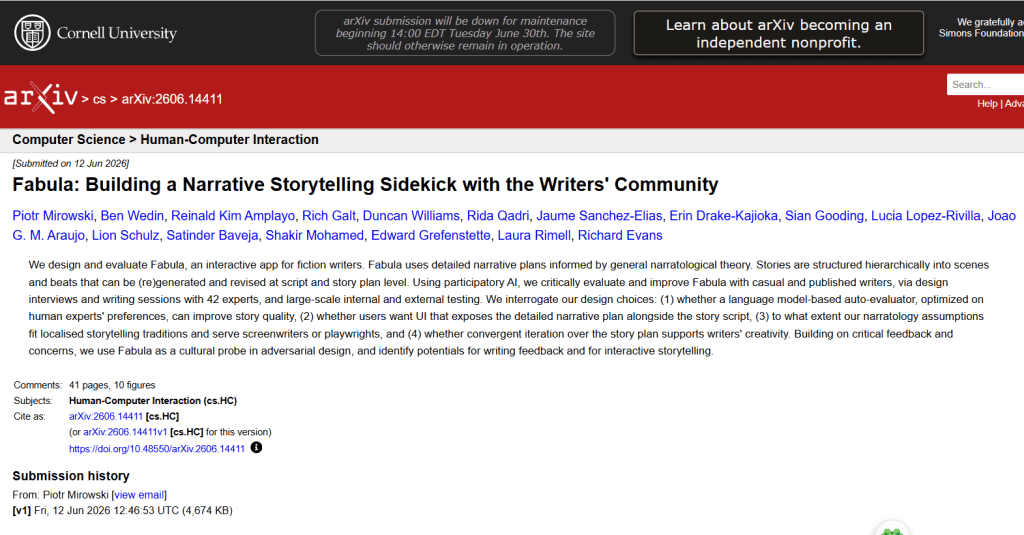
The paper detailed the system’s design philosophy, participatory development process, hierarchical narrative planning, and early evaluation with writers.
Why Fabula Represents a New Direction
- Fabula takes the opposite approach to other AI tools. It recognises that storytelling is a deeply personal process and positions AI as a creative partner that preserves complete human authorship.
- It reflects Google DeepMind’s vision for the future of collaborative human-AI storytelling.
Core Architecture of Google’s Fabula AI
Google DeepMind’s Fabula AI follows hierarchical narrative architecture. It does not treat stories as a block of text, but organises stories into connected layers. It is designed to understand the relationships between the different parts of the narrative to assist writers more effectively.
Its simplified structure looks like this: Story → Acts → Scenes → Beats → Dialogue → Screenplay.
The overall story concept is followed by acts, which divide the story into major structural sections. Each act is further divided into scenes. Each scene contains multiple beats for dramatic action or emotional progression. Finally, these beats are transformed into dialogue and screenplay.
This structure allows Fabula to maintain consistency across complex long-form narratives.
In fact, using this, if a writer wants to change an early scene, Fabula AI can help identify how later scenes might need adjustment to maintain the natural flow. It combines with the platform’s writer-in-the-loop philosophy. This architecture makes it an intelligent storytelling companion and ensures that the human writer has complete creative control.
Key Features of Google DeepMind’s Fabula AI
Google has not publicly released its Fabula AI, but Google’s demonstrations and research papers reveal several capabilities.
- Interactive story planning. Fabula AI can help writers organise ideas before drafting. Means writers can create structured narrative plans that evolve throughout the writing process.
- Hierarchical story management. Rather than editing single paragraphs, writers work across interconnected narrative levels.
- Fabula AI helps maintain continuity across characters, locations, themes, and plotlines, even when introduced hundreds of pages earlier.
- Its AI brainstorming assistance encourages exploration. Writers can examine multiple possibilities before choosing their preferred direction.
- It is powered by Google’s Gemini language models. This allows it to understand storytelling structures more effectively.
- Designed to work alongside writers rather than replace them. Every suggestion is optional, so that authors retain complete creative control over their stories.
- Fabula breaks stories into scenes and dramatic beats that ultimately help writers build stronger pacing and emotional flow throughout the narratives.
- When writers modify characters, scenes, or plotlines, Fabula can identify related narrative elements that may require updates.
Google Fabula AI vs. Fabula Writing App
Mostly, writers confuse Fabula AI with the Fabula writing app due to the similarity in their names. However, Google DeepMind’s Fabula AI and Fabula Writing Software are entirely different products.
Here’s a detailed comparison.
| Feature | Google’s Fabula AI | Fabula Writing App |
| Developer | Developed by Google Research and Google DeepMind as an experimental AI storytelling project. | Developed by an independent company as a commercial story planning and writing application. |
| Purpose | Designed to assist writers with AI-powered narrative while preserving creative control. | Designed to help writers organise characters, plots, timelines, and story notes without relying on AI. |
| Technology | Powered by Google’s Gemini language models to provide intelligent storytelling suggestions. | Is a story organisation with traditional writing and planning tools. |
| Availability | Currently a research prototype. Not available for public download. | Publicly available software that writers can purchase for everyday writing projects. |
| Target Audience | Built mainly for screenwriters, playwrights, and long-form storytellers. | Suitable for authors seeking story planning and project management tools. |
Anyone searching for “Fabula” should verify which product they are referring to.
Advantages of Using Fabula AI
- The system can offer intelligent suggestions while preserving complete creative ownership. That makes storytelling a collaborative human-AI experience.
- Its hierarchical planning system helps organise stories into acts, scenes, and beats. That improves long-term narrative and makes it stronger with better pacing and logical flow.
- Unlike many AI tools designed by engineers, Fabula gathered feedback from 42 professional writers. That makes this AI more precise for screenwriters.
- The Fabula AI can brainstorm multiple story ideas that help writers overcome writer’s block and explore new directions.
- Fabula AI allows authors to accept, modify, or reject every AI suggestion as needed.
Disadvantages of Using Fabula AI
- Fabula is still in an experimental phase. Their early access appears limited to research collaborations and demonstrations. Most writers cannot currently access it because no public download.
- Google has released only research papers and demonstrations of Fabula AI. Possibly many technical features and implementation details are undisclosed.
- Fabula is an active research project that may evolve significantly before any commercial release. That can change current features or be modified over time.
- Its public launch date or pricing is yet to be announced. Due to access limitations, independent reviewers cannot review it. Its effectiveness across different writing styles is largely unverified.
- Google has not disclosed whether Fabula will integrate with popular writing software, screenwriting tools, or publishing platforms in the future.
Future Roadmap for Fabula AI
Google has not announced an official roadmap yet. However, based on current research, Fabula could expand into screenwriting software, audio-drama production, novel writing software, and story visualisation software. Maybe future versions will also integrate more deeply with Gemini’s multimodal capabilities.
Note: These possibilities are theoretical rather than confirmed features until Google announces commercial plans.
Final Words
If Google DeepMind has announced Fabula AI, it could be the most preferred AI-assisted storytelling tool with the best collaborator. It is a glimpse of the future of AI-assisted storytelling.
Writers, Artificial intelligence is the future of storytelling. You can’t be afraid of its presence. Always remember that your words are yours, your voice is yours, your emotions are yours, your experiences are yours, your expressions are yours. AI can’t replace them; it can only suggest a patternised way to reveal, which is more friendly for industry purposes.
Now, it is your turn, screenwriters!
I’d love to hear from you!
- Do you think Fabula AI could change the future of storytelling?
- Would you use an AI co-creation tool like Fabula for your writing projects?
- Which feature impressed you the most, and what additional features would you like Google to introduce in Fabula AI?
Share your thoughts in the comments below.
Also, if you found this guide helpful, please share it with your fellow writers. It will help them stay informed about new AI technologies emerging in the writing world.
And don’t forget to share your valuable feedback. Your every word matters to us and helps us grow as a better community.
I have also attached a link to the Professional Screenwriting Workbook, Audio Story Scriptwriting Workbook and Novel Writing Workbook, all in one place. You can purchase your copy and learn to develop powerful and industry-ready stories anytime, anywhere.
Simran Thakur
Founder & CEO, AFAWW
Author| Screenwriter| Audio story scriptwriter| Blogger| Poet














Leave a comment